Test Index
Wave Optics
Wave Optics

 CBSE Board Videos
© examsnet.com
Question : 23 of 31
Marks:
+1,
-0
(a) Using Huygens' principle, draw a ray diagram showing the propagation of a plane wave refracting at a plane surface separating two media. Also verify Snell's law of refraction.OR(b) Why is a reflecting telescope preferred over a refracting telescope ? Justify your answer giving two reasons.
[CBSE 2023 55/1/1]
Solution:
(a)Let a plane wavefront AB be incident at angle on the surface separating medium 1 (speed ) and medium 2 (speed ). Let be the time taken by the disturbance at B to reach C, so .In this time the secondary wavelet from A travels into medium 2 a distance . Draw a sphere of radius about A and the tangent plane CE from C to it: CE is the refracted wavefront, and the angle it makes with the surface is the angle of refraction .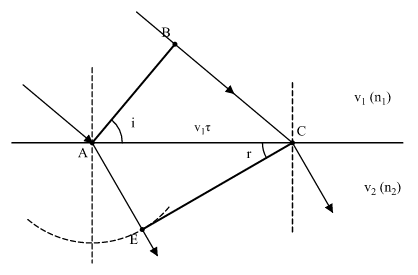 Verification of Snell's law:In right triangle ABC: In right triangle AEC: With and : , i.e. This is Snell's law of refraction.OR (b)A reflecting telescope (concave mirror objective) is preferred because:1. No chromatic aberration: a mirror only reflects; there is no refraction and no dispersion, so all colours are focused at the same point. A lens objective splits colours.2. Less spherical aberration: a parabolic mirror brings parallel rays to one focus, removing spherical aberration.3. Easy mechanical support and large aperture: a mirror weighs much less than a lens of the same size and can be supported over its whole back surface, so very large objectives can be made. A large aperture gathers more light (brighter image) and gives a higher resolving power. Large lenses are heavy, sag and are hard to make free of defects.(Any two of these.)
© examsnet.com
Go to Question: