Test Index
Wave Optics
Wave Optics

 CBSE Board Videos
© examsnet.com
Question : 21 of 31
Marks:
+1,
-0
(a) (i) In diffraction due to a single slit, the phase difference between light waves reaching a point on the screen is . Explain whether a bright or a dark fringe will be formed at the point.(ii) What should the width () of each slit be to obtain eight maxima of two double-slit patterns (slit separation ) within the central maximum of the single slit pattern ?(iii) Draw the plot of intensity distribution in a diffraction pattern due to a single slit.OR(b) (i) In a Young's double-slit experiment , where and are the two slits as shown in the figure. Find the path difference for constructive and destructive interference at P.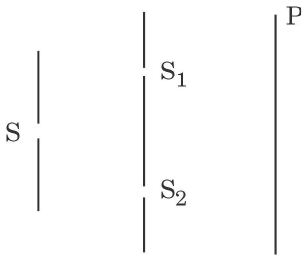 (ii) What is the effect on the interference fringes in a Young's double-slit experiment, if the monochromatic source S is replaced by a source of white light ?
[CBSE 2023 55/4/1]
Solution:
(a)(i) For a single slit, the phase difference between the waves from the two edges of the slit is .Minima (dark) occur when (); secondary maxima (bright) occur when ()., i.e. path difference , so a bright fringe (second secondary maximum) is formed at the point.(a)(ii) Angular width of the central maximum of the single slit ; angular fringe width of the double-slit pattern .For eight double-slit maxima within the central maximum:(a)(iii) Intensity distribution for a single slit: a bright, wide central maximum with much weaker secondary maxima on either side, minima at 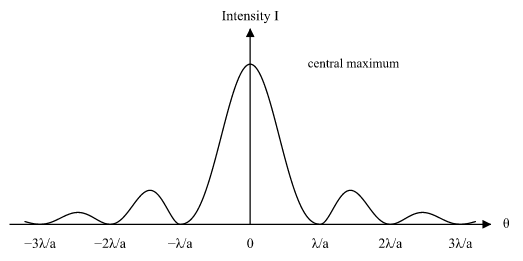 OR (b)(i) Total path difference between the two waves reaching P:Constructive interference: , Destructive interference: , (b)(ii) With white light, each colour forms its own fringe pattern with a different fringe width (). The central fringe is white (zero path difference for all colours). On either side a few coloured fringes appear, the one closest to the centre being blue (shorter ) and the farther one red. After a few fringes the colours overlap and no clear fringe pattern is seen.
© examsnet.com
Go to Question: