Test Index
Wave Optics
Wave Optics

 CBSE Board Videos
© examsnet.com
Question : 16 of 31
Marks:
+1,
-0
(a) (i) Give any two differences between the interference pattern obtained in Young's double-slit experiment and a diffraction pattern due to a single slit.(ii) Draw an intensity distribution graph in case of a double-slit interference pattern.(iii) In Young's double-slit experiment using monochromatic light of wavelength , the intensity of light at a point on the screen, where path difference is , is K units. Find the intensity of light at a point on the screen where the path difference is .OR(b) (i) Draw a labelled ray diagram of a compound microscope showing image formation at least distance of distinct vision. Derive an expression for its magnifying power.(ii) A telescope consists of two lenses of focal length cm and cm. Find the magnifying power when the final image is formed at infinity.
[CBSE 2024 55/2/2]
Solution:
(a)(i) Differences (any two):1. Interference: all bright fringes are of equal width (equally spaced). Diffraction: the central maximum is twice as wide as the other maxima.2. Interference: all bright fringes have (nearly) the same intensity. Diffraction: the intensity of the secondary maxima falls rapidly on going away from the central maximum.3. Interference: at angle there is a maximum (for slit separation a). Diffraction: at angle (slit width a) there is a minimum.4. Interference results from superposition of waves from two coherent sources; diffraction from superposition of wavelets from different points of the same wavefront.(a)(ii) Intensity distribution in double-slit interference (equally bright maxima of intensity , zero-intensity minima):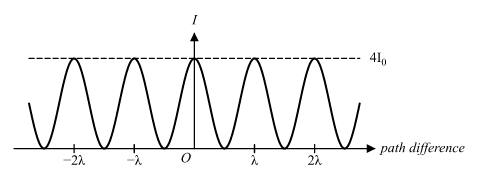 (a)(iii) , with phase difference (path difference).Path difference : , Path difference : Result: OR (b)(i) Compound microscope, final image at the least distance of distinct vision D:
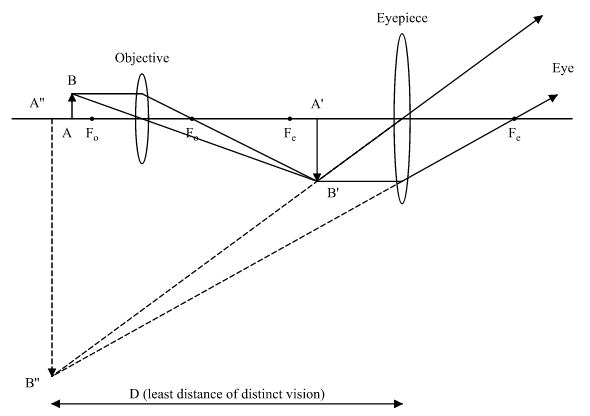 The objective forms a real, inverted, magnified image A′B′ of the object AB; A′B′ lies within the focal length of the eyepiece, which forms the final virtual, magnified image A″B″ at distance D.Magnification by the objective: (in magnitude ; since the object is close to and the image near the eyepiece, , L = tube length)Magnification by the eyepiece (acting as a simple microscope, image at D): Magnifying power: In magnitude: (b)(ii) For a telescope in normal adjustment (final image at infinity), the objective has the larger focal length:Result: Magnifying power (the final image is inverted).
© examsnet.com
Go to Question: