Test Index
Wave Optics
Wave Optics

 CBSE Board Videos
© examsnet.com
Question : 1 of 31
Marks:
+1,
-0
(a) State Huygens principle. How did Huygens justify the absence of the backwave on a spherical wavefront?OR(b) In a single-slit diffraction experiment, light of wavelength illuminates the slit of width ''. The diffraction pattern is observed on a screen kept at a distance from the slits.(i) Depict variation of intensity in the fringe pattern with the angular position of the fringes.(ii) How is the linear width of central maximum affected when separation between the slit and the screen is decreased?
[CBSE 2026 55/4/3]
Solution: 👈: Video Solution
(a)Huygens principle:1. Every point of a wavefront acts as a source of secondary disturbance, sending out secondary wavelets in all directions with the speed of the wave in that medium.2. The common forward envelope (tangent surface) of these secondary wavelets gives the new position of the wavefront at a later time.Absence of the backwave: The wavelets would also form a wavefront travelling backwards, which is not observed. Huygens removed it by assuming that the amplitude of the secondary wavelets is maximum in the forward direction and zero in the backward direction (amplitude , which is for ). So no backwave is formed.OR (b)(b)(i) Intensity is largest at (central maximum). Minima occur at (), and secondary maxima of rapidly falling intensity lie near . The central maximum is twice as wide as each secondary maximum.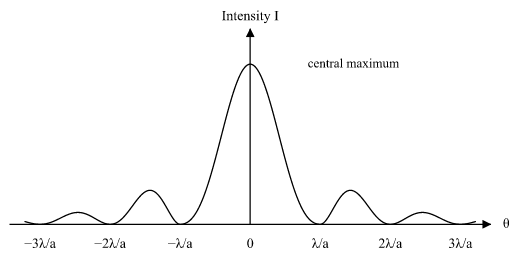 (b)(ii) Linear width of the central maximum:, so when the slit-screen separation is decreased, the linear width of the central maximum decreases (in the same ratio). Its angular width does not change.
© examsnet.com
Go to Question: