Test Index
Semiconductor Electronics: Materials, Devices and Simple Circuits
Semiconductor Electronics: Materials, Devices and Simple Circuits

 CBSE Board Videos
© examsnet.com
Question : 48 of 53
Marks:
+1,
-0
Explain the formation of depletion region in a p-n junction.
[CBSE 2022 55/2/1]
Solution:
Concept:When a p-type and an n-type semiconductor are joined, the n-side has many free electrons and the p-side has many holes. Two processes, diffusion and drift, form the depletion region.Explanation:(i) Diffusion: because of the difference in concentration, electrons diffuse from the n-side to the p-side and holes diffuse from the p-side to the n-side. This gives a diffusion current across the junction.(ii) Immobile ions are left behind: an electron leaving the n-side leaves behind an ionised donor, an immobile positive ion. A hole leaving the p-side leaves behind an ionised acceptor, an immobile negative ion. The electrons and holes that cross also recombine on the other side.(iii) So a thin layer of immobile positive ions forms on the n-side and a layer of immobile negative ions on the p-side of the junction. This layer has no free charge carriers, so it is called the depletion region (thickness about one-tenth of a micrometre).(iv) The space charge of these ions sets up an electric field from the n-side to the p-side. This field makes minority carriers drift across the junction (drift current, opposite to the diffusion current) and opposes further diffusion. When the drift current equals the diffusion current, the depletion region stops growing. A potential difference (the potential barrier) is then set up across the junction.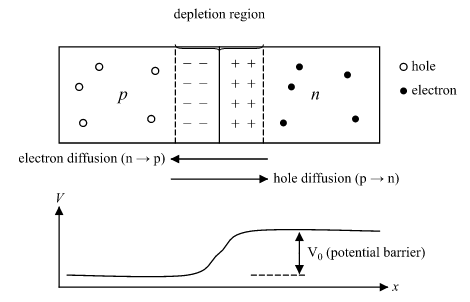 Key point: The depletion region contains only fixed (immobile) ions: negative ions on the p-side and positive ions on the n-side.
© examsnet.com
Go to Question: