Test Index
Semiconductor Electronics: Materials, Devices and Simple Circuits
Semiconductor Electronics: Materials, Devices and Simple Circuits

 CBSE Board Videos
© examsnet.com
Question : 43 of 53
Marks:
+1,
-0
Explain the roles of diffusion current and drift current in the formation of the depletion layer in a p-n junction diode.
[CBSE 2023 55/3/1]
Solution:
Role of diffusion current:When a p-n junction is formed, there are many holes on the p-side and many electrons on the n-side. Because of this concentration gradient, holes diffuse from p to n and electrons diffuse from n to p; this motion is the diffusion current (from p to n).An electron that leaves the n-side leaves behind an immobile positive donor ion; a hole that leaves the p-side leaves behind an immobile negative acceptor ion. These layers of uncovered fixed ions on both sides of the junction, which have no free charge carriers, form the depletion layer.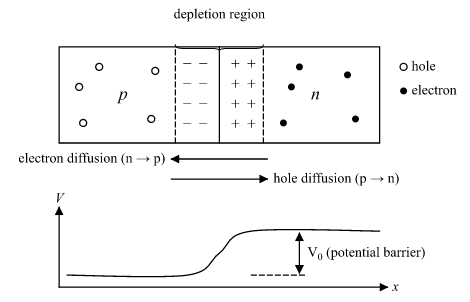 Role of drift current:The positive ions on the n-side and negative ions on the p-side set up an electric field from n to p across the junction (the barrier potential). This field pushes minority carriers across the junction: electrons from p to n and holes from n to p. This motion is the drift current, opposite to the diffusion current.Equilibrium:At first the diffusion current is large and the drift current small. As diffusion continues, the space charge and the field grow, so the drift current increases. When the drift current becomes equal to the diffusion current, there is no net current, and the depletion layer stops growing; its width and the barrier potential become fixed.
© examsnet.com
Go to Question: