Test Index
Semiconductor Electronics: Materials, Devices and Simple Circuits
Semiconductor Electronics: Materials, Devices and Simple Circuits

 CBSE Board Videos
© examsnet.com
Question : 24 of 53
Marks:
+1,
-0
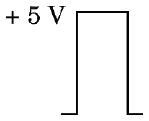
Questions number 29 and 30 are case study-based questions. Read the following paragraphs and answer the questions that follow.Junction Diode as a Rectifier :The process of conversion of an ac voltage into a dc voltage is called rectification and the device which performs this conversion is called a rectifier. The characteristics of a p-n junction diode reveal that when a p-n junction diode is forward biased, it offers a low resistance and when it is reverse biased, it offers a high resistance. Hence, a p-n junction diode conducts only when it is forward biased. This property of a p-n junction diode makes it suitable for its use as a rectifier.Thus, when an ac voltage is applied across a p-n junction, it conducts only during those alternate half cycles for which it is forward biased. A rectifier which rectifies only half cycle of an ac voltage is called a half-wave rectifier and one that rectifies both the half cycles is known as a full-wave rectifier.(i) The root mean square value of an alternating voltage applied to a full-wave rectifier is . Then the root mean square value of the rectified output voltage is : (1)(A) (B) (C) (D) (ii) In a full-wave rectifier, the current in each of the diodes flows for : (1)(A) Complete cycle of the input signal(B) Half cycle of the input signal(C) Less than half cycle of the input signal(D) Only for the positive half cycle of the input signal(iii) In a full-wave rectifier : (1)(A) Both diodes are forward biased at the same time.(B) Both diodes are reverse biased at the same time.(C) One is forward biased and the other is reverse biased at the same time.(D) Both are forward biased in the first half of the cycle and reverse biased in the second half of the cycle.(iv) (a) An alternating voltage of frequency of 50 Hz is applied to a half-wave rectifier. Then the ripple frequency of the output will be : (1)(A) 100 Hz(B) 50 Hz(C) 25 Hz(D) 150 HzOR(b) A signal, as shown in the figure, is applied to a p-n junction diode. Identify the output across resistance : (1)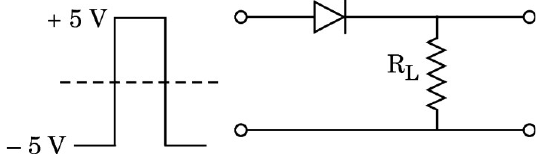 (A)
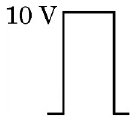 (B)
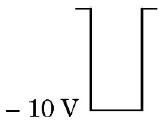 (C)
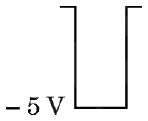 (D)
[CBSE 2024 55/1/2]
Solution:
(i) A full-wave rectifier passes both halves of the input, the negative half being inverted: output . Squaring removes the sign, so the mean of is the same as for the input: .Answer: (A) (ii) In a full-wave rectifier the two diodes conduct in alternate half cycles: one during the positive half and the other during the negative half. So each diode carries current for half a cycle of the input.Answer: (B) Half cycle of the input signal(iii) The two ends of the centre-tapped secondary are always in opposite phase. When one diode's anode is positive (forward biased), the other diode's anode is negative (reverse biased), and they swap in the next half cycle.Answer: (C) One is forward biased and the other is reverse biased at the same time.(iv)(a) A half-wave rectifier gives one output pulse per input cycle, so the ripple frequency equals the input frequency, Hz. (A full-wave rectifier would give Hz.)Answer: (B) 50 HzOR (iv)(b) During the V part of the signal the p-side (anode) of the diode is positive, so the diode is forward biased and conducts; an ideal diode passes the full V to . During the V part the diode is reverse biased, no current flows and the output across is zero. The output is therefore a single positive pulse of V, with zero elsewhere.Answer: (D) (the V pulse)
© examsnet.com
Go to Question: