Test Index
Semiconductor Electronics: Materials, Devices and Simple Circuits
Semiconductor Electronics: Materials, Devices and Simple Circuits

 CBSE Board Videos
© examsnet.com
Question : 21 of 53
Marks:
+1,
-0
(a) What are majority and minority charge carriers in an extrinsic semiconductor?(b) A p-n junction is forward biased. Describe the movement of the charge carriers which produce current in it.(c) The graph shows the variation of current with voltage for a p-n junction diode.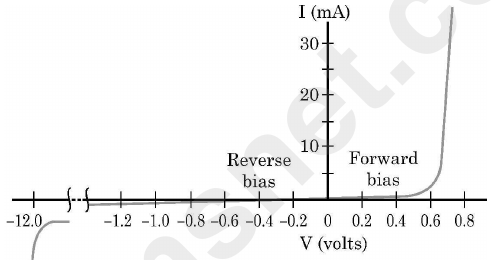 Estimate the dynamic resistance of diode at volt.
[CBSE 2025 55/2/1]
Solution:
(a) In an extrinsic semiconductor the charge carriers present in large number are the majority carriers and those present in small number are the minority carriers. In an n-type semiconductor electrons are majority carriers and holes are minority carriers; in a p-type semiconductor holes are majority and electrons are minority carriers.(b) In forward bias the applied voltage opposes the barrier potential, so the depletion layer becomes thinner and the barrier lower. Electrons from the n-side cross the junction into the p-side and holes from the p-side cross into the n-side (minority carrier injection). These injected carriers diffuse away from the junction, and the diffusion of holes and electrons together produces the forward current (of the order of mA).(c) Dynamic resistance .At the diode is reverse biased. The graph shows the current is practically zero there and does not change when changes (only a tiny, constant reverse saturation current flows), so .Result: ; the dynamic resistance at is very large (practically infinite).
© examsnet.com
Go to Question: