Test Index

Ray Optics and Optical Instruments Get it on Google PlayDownload on the App Store CBSE Board Videos

© examsnet.com
Question : 8 of 46
Marks: +1, -0
(a) Using the relation for refraction at a curved spherical surface, derive the expression for lens maker's formula.
(b) Three lenses L1L_1, L2L_2 and L3L_3, each of focal length 40 cm40 \text{ cm}, are placed coaxially. The distance between L1L_1 and L2L_2 and between L2L_2 and L3L_3 are 120 cm120 \text{ cm} and 20 cm20 \text{ cm} respectively. An object is kept at a distance of 80 cm80 \text{ cm} to the left of lens L1L_1.
Find the distance of the final image formed from the object.
OR
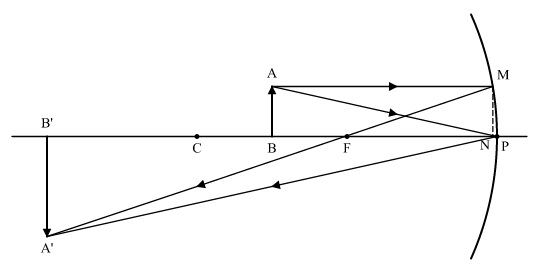
(a) Draw a ray diagram to show the image formation by a concave mirror when the object is kept between its focus and the centre of curvature. Using this diagram, derive the mirror formula.
(b) A concave mirror produces a two times magnified virtual image of an object kept 10 cm10 \text{ cm} in front of it. Calculate the focal length of the mirror.
[CBSE 2026 55/1/3]
Solution:  
(a) Lens maker's formula
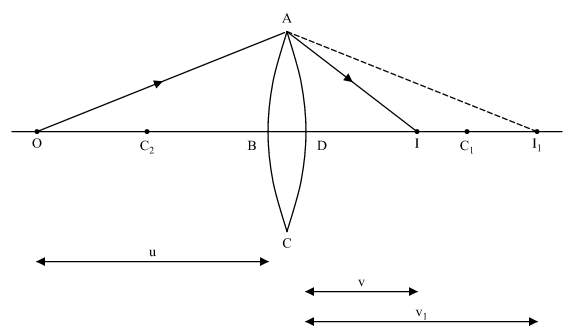
Consider a thin lens of refractive index n2n_2 placed in a medium of refractive index n1n_1. Its surfaces ABC and ADC have radii of curvature R1R_1 (centre C1C_1) and R2R_2 (centre C2C_2). A point object O is on the principal axis.
Refraction at a spherical surface: n2v−n1u=n2−n1R\dfrac{n_2}{v} - \dfrac{n_1}{u} = \dfrac{n_2 - n_1}{R}
First surface ABC (rays go from n1n_1 to n2n_2): it alone would form the image I1I_1:
n1OB+n2BI1=n2−n1BC1\dfrac{n_1}{OB} + \dfrac{n_2}{BI_1} = \dfrac{n_2 - n_1}{BC_1} ...(1)
Second surface ADC (from n2n_2 to n1n_1): I1I_1 acts as a virtual object and the final image is formed at I:
−n2DI1+n1DI=n2−n1DC2-\dfrac{n_2}{DI_1} + \dfrac{n_1}{DI} = \dfrac{n_2 - n_1}{DC_2} ...(2)
For a thin lens BI1≈DI1BI_1 \approx DI_1. Adding (1) and (2):
n1OB+n1DI=(n2−n1)(1BC1+1DC2)\dfrac{n_1}{OB} + \dfrac{n_1}{DI} = (n_2 - n_1)\left(\dfrac{1}{BC_1} + \dfrac{1}{DC_2}\right)
Sign convention (distances from the optical centre): OB=−uOB = -u, DI=+vDI = +v, BC1=+R1BC_1 = +R_1, DC2=−R2DC_2 = -R_2:
−n1u+n1v=(n2−n1)(1R1−1R2)-\dfrac{n_1}{u} + \dfrac{n_1}{v} = (n_2 - n_1)\left(\dfrac{1}{R_1} - \dfrac{1}{R_2}\right)
1v−1u=(n2n1−1)(1R1−1R2)\dfrac{1}{v} - \dfrac{1}{u} = \left(\dfrac{n_2}{n_1} - 1\right)\left(\dfrac{1}{R_1} - \dfrac{1}{R_2}\right)
For an object at infinity (u=∞u = \infty) the image is at the focus (v=fv = f):
1f=(n21−1)(1R1−1R2),n21=n2n1\dfrac{1}{f} = (n_{21} - 1)\left(\dfrac{1}{R_1} - \dfrac{1}{R_2}\right), \quad n_{21} = \dfrac{n_2}{n_1}This is the lens maker's formula.
(b)
Given: f=+40 cmf = +40 \text{ cm} for each lens; L1L2=120 cmL_1L_2 = 120 \text{ cm}, L2L3=20 cmL_2L_3 = 20 \text{ cm}; object 80 cm80 \text{ cm} to the left of L1L_1.
Lens formula: 1v−1u=1f\dfrac{1}{v} - \dfrac{1}{u} = \dfrac{1}{f}
Lens L1L_1: u1=−80 cmu_1 = -80 \text{ cm}
1v1=140−180=180⇒v1=+80 cm\dfrac{1}{v_1} = \dfrac{1}{40} - \dfrac{1}{80} = \dfrac{1}{80} \Rightarrow v_1 = +80 \text{ cm} (real image 80 cm80 \text{ cm} to the right of L1L_1)
Lens L2L_2: this image is 120−80=40 cm120 - 80 = 40 \text{ cm} to the left of L2L_2, so u2=−40 cmu_2 = -40 \text{ cm}
1v2=140−140=0⇒v2=∞\dfrac{1}{v_2} = \dfrac{1}{40} - \dfrac{1}{40} = 0 \Rightarrow v_2 = \infty (the object is at the focus of L2L_2; the rays leave L2L_2 parallel)
Lens L3L_3: parallel rays, u3=∞u_3 = \infty, so v3=f=+40 cmv_3 = f = +40 \text{ cm} to the right of L3L_3.
Distance of the final image from the object =80+120+20+40=260 cm= 80 + 120 + 20 + 40 = 260 \text{ cm}
Result: The final image is formed 260 cm260 \text{ cm} from the object (40 cm to the right of L3L_3).
OR (a) Ray diagram and mirror formula
Object AB lies between F and C. The ray AM parallel to the axis reflects through F; the ray AP striking the pole reflects making an equal angle with the axis. They meet at A'. The image A'B' is real, inverted, magnified and lies beyond C. MN is the perpendicular from M to the axis.
In the right-angled triangles A′B′FA'B'F and MNFMNF (for paraxial rays NF≈PFNF \approx PF):
B′A′NM=B′FNF⇒B′A′BA=B′FPF\dfrac{B'A'}{NM} = \dfrac{B'F}{NF} \Rightarrow \dfrac{B'A'}{BA} = \dfrac{B'F}{PF} (since NM=BANM = BA) ...(1)
Since ∠APB=∠A′PB′\angle APB = \angle A'PB' (law of reflection), triangles A′B′PA'B'P and ABPABP are similar:
B′A′BA=B′PBP\dfrac{B'A'}{BA} = \dfrac{B'P}{BP} ...(2)
From (1) and (2): B′FPF=B′PBP⇒B′P−PFPF=B′PBP\dfrac{B'F}{PF} = \dfrac{B'P}{BP} \Rightarrow \dfrac{B'P - PF}{PF} = \dfrac{B'P}{BP}
Cartesian signs (all distances measured from P, against the incident light are negative): B′P=−vB'P = -v, PF=−fPF = -f, BP=−uBP = -u:
−v+f−f=−v−u⇒v−ff=vu⇒vf−1=vu\dfrac{-v + f}{-f} = \dfrac{-v}{-u} \Rightarrow \dfrac{v - f}{f} = \dfrac{v}{u} \Rightarrow \dfrac{v}{f} - 1 = \dfrac{v}{u}
Dividing by vv:
1v+1u=1f\dfrac{1}{v} + \dfrac{1}{u} = \dfrac{1}{f}This is the mirror formula.
OR (b)
Given: u=−10 cmu = -10 \text{ cm}, virtual erect image, so m=+2m = +2.
m=−vu⇒2=−v−10⇒v=+20 cmm = -\dfrac{v}{u} \Rightarrow 2 = -\dfrac{v}{-10} \Rightarrow v = +20 \text{ cm} (behind the mirror)
1f=1v+1u=120−110=−120\dfrac{1}{f} = \dfrac{1}{v} + \dfrac{1}{u} = \dfrac{1}{20} - \dfrac{1}{10} = -\dfrac{1}{20}
f=−20 cmf = -20 \text{ cm}
Result: The focal length of the concave mirror is 20 cm20 \text{ cm} (f=−20 cmf = -20 \text{ cm}).
© examsnet.com
Advertisements
Go to Question: