Test Index
Ray Optics and Optical Instruments
Ray Optics and Optical Instruments

 CBSE Board Videos
© examsnet.com
Question : 6 of 46
Marks:
+1,
-0
(a) State the two conditions under which total internal reflection occurs.(b)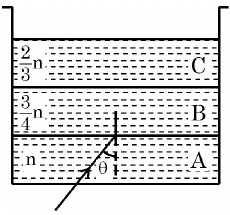 A transparent container contains layers of three immiscible transparent liquids A, B and C of refractive indices , and , respectively. A laser beam is incident at the interface between A and B at an angle as shown in figure. Prove that the beam does not enter region C at all for .
[CBSE 2026 55/1/3]
Solution:
(a) Total internal reflection occurs when(i) light travels from an optically denser medium to an optically rarer medium, and(ii) the angle of incidence in the denser medium is greater than the critical angle for the pair of media (, where ).(b)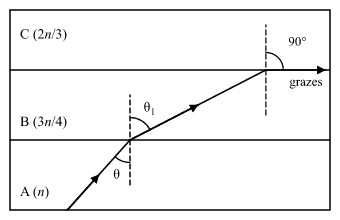 Let the ray make angle with the normal in B and angle with the normal in C.Snell's law at the A-B interface: ...(1)Snell's law at the B-C interface: ...(2)From (1) and (2): For : , . The ray just grazes along the B-C interface (critical incidence at that surface).For : would exceed , which is impossible, so there is no refracted ray into C: the light is totally internally reflected (at the B-C interface, or already at the A-B interface once ).Hence for the beam does not enter region C at all.Key point: In parallel layers stays the same across every interface, so only the first and last media matter: the condition is .
© examsnet.com
Go to Question: