Test Index
Ray Optics and Optical Instruments
Ray Optics and Optical Instruments

 CBSE Board Videos
© examsnet.com
Question : 46 of 46
Marks:
+1,
-0
A ray of light travels from a denser to a rarer medium. After refraction, it bends away from the normal. When we keep increasing the angle of incidence, the angle of refraction also increases till the refracted ray grazes along the interface of two media. The angle of incidence for which it happens is called critical angle. If the angle of incidence is increased further the ray will not emerge and it will be reflected back in the denser medium. This phenomenon is called total internal reflection of light.(i) A ray of light travels from a medium into water at an angle of incidence of . The refractive index of the medium is more than that of water and the critical angle for the interface between the two media is . Which one of the following figures best represents the correct path of the ray of light?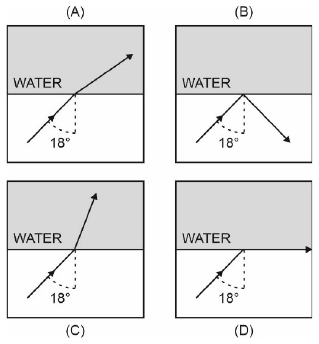 (ii) A point source of light is placed at the bottom of a tank filled with water, of refractive index , to a depth . The area of the surface of water through which light from the source can emerge, is(a) (b) (c) (d) (iii) For which of the following media, with respect to air, the value of critical angle is maximum?(a) Crown glass (b) Flint glass(c) Water (d) Diamond(iv) The critical angle for a pair of two media A and B of refractive indices and respectively is(a) (b) (c) (d) (v) The critical angle of pair of a medium and air is . The speed of light in the medium is(a) (b) (c) (d)
[CBSE 2022 55/5/3]
Solution:
(i) The angle of incidence is less than the critical angle , so there is no total internal reflection; the ray refracts into water (rarer medium) bending away from the normal.Figure (A) shows the ray entering water and bending away from the normal. ((B) is total internal reflection, which needs ; (C) bends towards the normal; (D) is the grazing ray for .)Answer: (A)(ii) Light emerges only within a cone of half-angle (critical angle), giving a circle of radius on the surface.Area Answer: (b) (iii) , so the critical angle is largest for the smallest refractive index. Water () has a smaller than crown glass (), flint glass () and diamond (), so is the largest.Answer: (c) Water(iv) Answer: (b) (v) , so Answer: (b)
© examsnet.com
Go to Question: