Test Index
Ray Optics and Optical Instruments
Ray Optics and Optical Instruments

 CBSE Board Videos
© examsnet.com
Question : 44 of 46
Marks:
+1,
-0
With the help of a ray diagram, show how a compound microscope forms a magnified image of a tiny object, at least distance of distinct vision. Hence derive an expression for the magnification produced by it.
[CBSE 2022 55/5/3]
Solution:
Ray diagram: The objective (short focal length ) forms a real, inverted, magnified image of the tiny object placed just beyond its focus. The eyepiece acts as a simple magnifier: lies within its focal length, and the eyepiece forms the final virtual, magnified image at the least distance of distinct vision .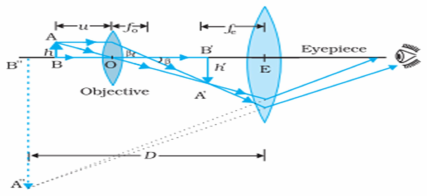 Magnification:Linear magnification by the objective: From the figure, , where (tube length) is the distance between the second focal point of the objective and the first focal point of the eyepiece. So ...(i)Magnification by the eyepiece (final image at , it works as a simple microscope): ...(ii)Total magnification: Key point: Both and are made small to get a large magnification.
© examsnet.com
Go to Question: