Test Index
Ray Optics and Optical Instruments
Ray Optics and Optical Instruments

 CBSE Board Videos
© examsnet.com
Question : 41 of 46
Marks:
+1,
-0
(a) Draw a labelled ray diagram showing the formation of an image by an astronomical refracting telescope in normal adjustment. Hence, obtain the expression for its magnifying power.OR(b) A plane wavefront of light of wavelength '' is incident normally on a narrow slit of width '' and a diffraction pattern is observed on a screen at a distance '' from the slit.(i) Depict the intensity distribution in the pattern observed.(ii) Obtain the expression for the first maximum from the central maximum.
[CBSE 2022 55/2/1]
Solution:
(a)In normal adjustment, the final image is at infinity. The objective forms a real, inverted image of a distant object at its focus, which is also the focus of the eyepiece.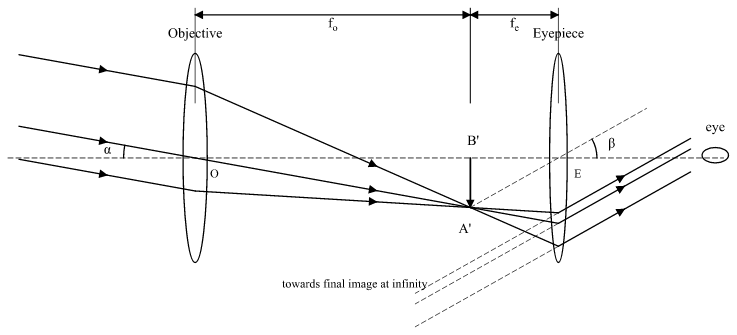 Magnifying power: it is the ratio of the angle subtended at the eye by the final image to the angle subtended at the eye (or objective) by the object:Let the size of the intermediate image be . Since the angles are small: (in the triangle at the objective) (in the triangle at the eyepiece)Result: , and the length of the telescope tube is .OR (b)(b)(i) Intensity distribution in single-slit diffraction:
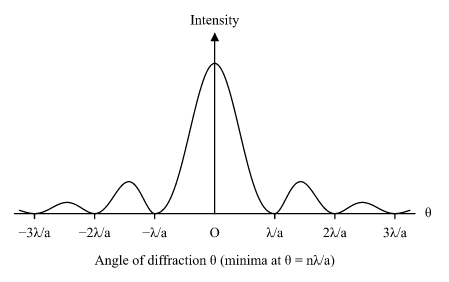 There is a bright central maximum, with minima at and secondary maxima of rapidly decreasing intensity between them.(b)(ii)Concept: The path difference between the waves from the two edges of the slit at angle is . A secondary maximum occurs when, For the first maximum (), divide the slit into three equal parts: the waves from two parts cancel each other and the third part gives light:For small : Distance from the centre of the central maximum on the screen at distance :Result:
© examsnet.com
Go to Question: