Test Index
Ray Optics and Optical Instruments
Ray Optics and Optical Instruments

 CBSE Board Videos
© examsnet.com
Question : 4 of 46
Marks:
+1,
-0
(a) (i) Define refractive index of a medium in terms of speed of light.(ii) Derive the relation for the refractive index of a prism in terms of angle of minimum deviation and angle of prism (A).(iii) A ray of light QP is incident normally on the face BC of a triangular prism ABC of refractive index kept in air, as shown in the figure. Trace the path of the ray as it passes through the prism and give relevant explanation.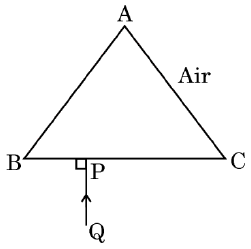 OR(b) (i) What is the difference between a ray and a wavefront ?(ii) A plane wave is incident on a reflecting surface. Using Huygens principle, show how it is reflected from the surface. Hence, verify the law of reflection.(iii) Depict refraction of a plane wave by a convex lens.
[CBSE 2026 55/4/3]
Solution: 👈: Video Solution
(a)(i) The (absolute) refractive index of a medium is the ratio of the speed of light in vacuum to the speed of light in that medium: .(a)(ii)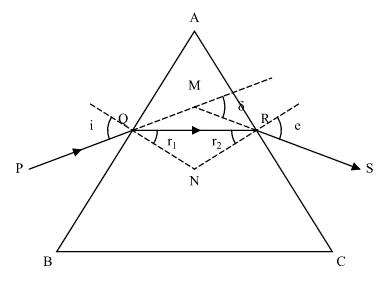 PQ is the incident ray, QR the refracted ray and RS the emergent ray; the normals at Q and R meet at N. and are the angles of incidence and emergence, and the angles of refraction inside, the angle of deviation.In quadrilateral AQNR, the angles at Q and R are , so .In triangle QNR, .Comparing: ...(1)Total deviation = deviation at the first face + deviation at the second face: ...(2)At minimum deviation , the ray passes symmetrically: and (QR parallel to the base).From (1): From (2): By Snell's law at the first face, :(a)(iii)
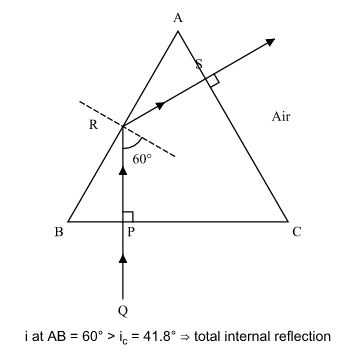 Take the prism as equilateral (), as the figure suggests.Critical angle: 1. At P the ray falls normally on BC (), so it enters the prism undeviated.2. It meets face AB. The ray is perpendicular to BC, so its angle of incidence on AB equals the angle between BC and AB, i.e. .3. Since (and the ray goes from glass to air), it suffers total internal reflection at AB.4. The reflected ray makes with AB and travels perpendicular to face AC, so it falls normally on AC and emerges into air without deviation.Key point: For a ray entering normally through BC, the angle of incidence on the next face equals the prism angle at the corner between them. Total internal reflection happens whenever that angle exceeds .OR (b)(i)Wavefront: the locus (surface) of all points of the medium that vibrate in the same phase at a given instant.Ray: a line drawn along the direction in which light energy travels; it is always normal to the wavefront at every point. (Spherical wavefront: rays radial; plane wavefront: rays parallel.)(b)(ii)
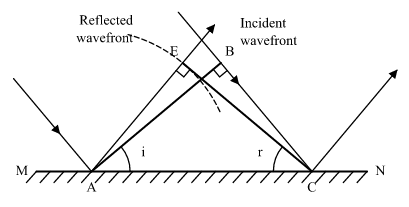 Let a plane wavefront AB be incident on the reflecting surface MN at angle ; A touches the surface first. Let be the speed of the wave and the time taken by the disturbance at B to reach C. Then .By Huygens principle, in the same time the secondary wavelet from A spreads into a hemisphere of radius (in the same medium). The tangent plane CE drawn from C to this hemisphere is the reflected wavefront, with .In triangles EAC and BAC:; AC is common; .So the triangles are congruent (RHS), and . (angle of incidence, angle between incident wavefront and surface) and (angle of reflection). Hence , which is the law of reflection. The incident ray, the reflected ray and the normal all lie in the plane of the figure.(b)(iii)
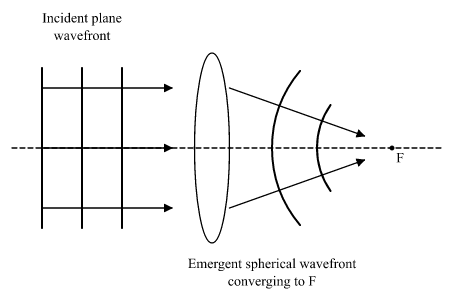 A plane wavefront falling on a convex lens: the central part passes through the thickest glass and is delayed most, the edges are delayed least. The emerging wavefront is therefore spherical and converges to the focus F (radius of curvature at the lens).
© examsnet.com
Go to Question: