Test Index
Ray Optics and Optical Instruments
Ray Optics and Optical Instruments

 CBSE Board Videos
© examsnet.com
Question : 39 of 46
Marks:
+1,
-0
Two transparent media of refractive indices and are separated by a spherical transparent surface. The rays of light incident on the surface get refracted into the medium on the other side. The laws of refraction are valid at each point of the spherical surface. A lens is a transparent optical medium bounded by two surfaces, at least one of which should be spherical. The focal length of a lens is determined by the radii of curvature ( and ) of its two surfaces and the refractive index () of the medium of the lens with respect to the surrounding medium. Depending on and , a lens behaves as a diverging or a converging lens. The ability of a lens to diverge or converge a beam of light incident on it defines its power. (5 × 1 = 5)(a) An object is placed at the point B as shown in the figure. The object distance () and the image distance () are related as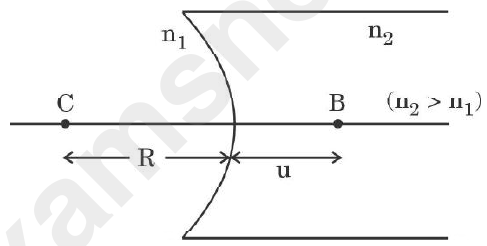 (i) (ii) (iii) (iv) (b) A point object is placed in air at a distance 'R' in front of a convex spherical refracting surface of radius of curvature R. If the medium on the other side of the surface is glass, then the image is :(i) real and formed in glass.(ii) real and formed in air.(iii) virtual and formed in glass.(iv) virtual and formed in air.(c) An object is kept at 2F in front of an equiconvex lens. The image formed is :(i) real and of the size of the object.(ii) virtual and of the size of the object.(iii) real and enlarged.(iv) virtual and diminished.(d) A thin converging lens of focal length cm and a thin diverging lens of focal length cm are placed coaxially in contact. The power of the combination is :(i) D(ii) D(iii) D(iv) D(e) An equiconcave lens of focal length 'f' is cut into two identical parts along the dotted line as shown in the figure. The focal length of each part will be :
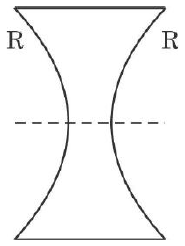 (i) (ii) (iii) (iv)
[CBSE 2022 55/4/3]
Solution:
(a) For refraction at a spherical surface, . Here the object B is in medium , so the light is incident from and refracted into :Answer: option (iv)(b) (air), (glass), , radius :The negative means the image is on the same side as the object.Answer: option (iv) virtual and formed in air(c) For an object at (): , so and . The image is at on the other side, real, inverted and of the same size.Answer: option (i) real and of the size of the object(d) D, DAnswer: option (ii) D(e) The cut is along the principal axis, so each part still has the same two curved surfaces with the same radii and the same material. By the lens maker's formula , the focal length does not change (only the aperture, and hence the brightness of the image, is reduced).Answer: option (iii)
© examsnet.com
Go to Question: