Test Index
Ray Optics and Optical Instruments
Ray Optics and Optical Instruments

 CBSE Board Videos
© examsnet.com
Question : 34 of 46
Marks:
+1,
-0
Strontium titanate is a rare oxide — a natural mineral found in Siberia. It is used as a substitute for diamond because its refractive index and critical angle are 2.41 and , respectively, which are approximately equal to the refractive index and critical angle of diamond. It has all the properties of diamond. Even an expert jeweller is unable to differentiate between diamond and strontium titanate. A ray of light is incident normally on one face of an equilateral triangular prism ABC made of strontium titanate.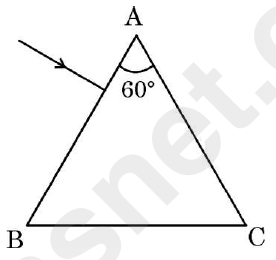 Answer the following questions based on the above :(a) Trace the path of the ray showing its passage through the prism. (1)(b) Find the velocity of light through the prism. (1)(c) Briefly explain two applications of total internal reflection. (2)OR(c) Define total internal reflection of light. Give two conditions for it. (2)
[CBSE 2023 55/1/1]
Solution:
(a) The ray falls normally on face AB, so it enters without deviation. Inside, it meets face AC at an angle of incidence (for normal entry, equals the prism angle ).Since , the ray is totally internally reflected at AC. The reflected ray falls normally on face BC and emerges undeviated.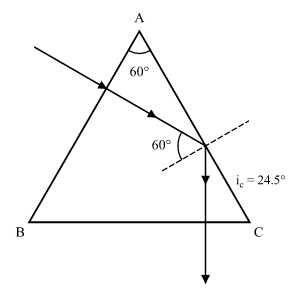 (b) (c) Applications of total internal reflection (any two):1. Optical fibres: a fibre has a core of higher refractive index than the cladding. Light entering one end strikes the core–cladding boundary at angles greater than the critical angle and is totally reflected again and again, so it travels to the other end with very little loss even if the fibre is bent. Used in telecommunication and in endoscopes.2. Brilliance of diamond: diamond has a very high refractive index (2.42) and a small critical angle (about ). It is cut so that light entering it suffers multiple total internal reflections before coming out, which makes it sparkle.(Other examples: totally reflecting prisms in periscopes and binoculars, mirage.)OR (c) Total internal reflection: when light travelling in an optically denser medium falls on the boundary with a rarer medium at an angle of incidence greater than the critical angle, it is completely reflected back into the denser medium. This is total internal reflection.Conditions:1. Light must travel from an optically denser medium to an optically rarer medium.2. The angle of incidence at the boundary must be greater than the critical angle for the pair of media.
© examsnet.com
Go to Question: