Test Index
Ray Optics and Optical Instruments
Ray Optics and Optical Instruments

 CBSE Board Videos
© examsnet.com
Question : 27 of 46
Marks:
+1,
-0
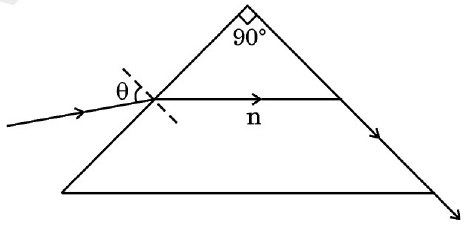
When a ray of light propagates from a denser medium to a rarer medium, it bends away from the normal. When the incident angle is increased, the refracted ray deviates more from the normal. For a particular angle of incidence in the denser medium, the refracted ray just grazes the interface of the two surfaces. This angle of incidence is called the critical angle for the pair of media involved.(i) For a ray incident at the critical angle, the angle of reflection is : (1)(A) (B) (C) (D) (ii) A ray of light of wavelength nm is incident in water on the water-air interface at an angle less than the critical angle. The wavelength associated with the refracted ray is : (1)(A) nm(B) nm(C) nm(D) nm(iii) (a) The interface AB between the two media A and B is shown in the figure. In the denser medium A, the incident ray PQ makes an angle of with the horizontal. The refracted ray is parallel to the interface. The refractive index of medium B w.r.t. medium A is : (1)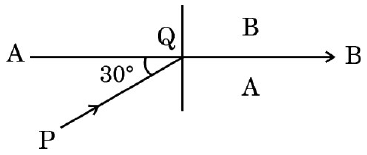 (A) (B) (C) (D) OR(b) Two media A and B are separated by a plane boundary. The speed of light in medium A and B is and respectively. The critical angle for a ray of light going from medium A to medium B is : (1)(A) (B) (C) (D) (iv) The figure shows the path of a light ray through a triangular prism. In this phenomenon, the angle is given by : (1)
 (A) (B) (C) (D)
[CBSE 2024 55/2/2]
Solution:
(i) When a ray is incident at the critical angle , the refracted ray grazes the surface, and a (weak) reflected ray also returns into the denser medium. By the law of reflection, angle of reflection = angle of incidence . Since the critical angle is always less than (because ), the angle of reflection is less than . (It is the angle of refraction that is .)Answer: (B) (ii) On refraction the frequency does not change, so . nmThe refracted ray is in air (rarer medium), so its wavelength is larger than in water.Key point: Going from water into air, the wavelength increases by the factor ; dividing by (450 nm) would give a wavelength for the opposite direction.Answer: (D) nm(iii)(a) The ray PQ makes with the interface, so the angle of incidence (with the normal) is . The refracted ray is along the interface, so (i.e. is the critical angle).Snell's law: Answer: (A) OR (iii)(b) Refractive index ; light goes from A (slower, denser) to B.Answer: (B) (iv) The prism angle is . The ray enters the first face at angle of incidence and refracts at angle ; it meets the second face at angle and emerges grazing along that face, so is the critical angle : .At the first face: Answer: (A)
© examsnet.com
Go to Question: