Test Index
Nuclei
Nuclei

 CBSE Board Videos
© examsnet.com
Question : 9 of 23
Marks:
+1,
-0
(a) Show the variation of binding energy per nucleon with mass number. Write the significance of the binding energy curve.(b) Two nuclei with lower binding energy per nucleon form a nuclei with more binding energy per nucleon.(i) What type of nuclear reaction is it?(ii) Whether the total mass of nuclei increases, decreases or remains unchanged?(iii) Does the process require energy or produce energy?
[CBSE 2025 55/2/1]
Solution:
(a)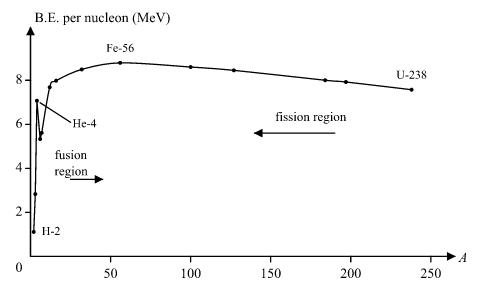 The binding energy per nucleon rises sharply for light nuclei, is almost constant at about for , reaches a maximum of about near (iron), and falls slowly to about for (uranium).Significance (any one):1. Light nuclei () can release energy by fusing into a heavier nucleus, and heavy nuclei () can release energy by splitting (fission), because in both cases the products are more tightly bound.2. The nearly constant value in the middle region shows that nuclear forces are short-ranged (they saturate).(b)(i) Nuclear fusion.(b)(ii) The total mass decreases; the mass defect appears as energy.(b)(iii) Energy is produced (released): .
© examsnet.com
Go to Question: