Test Index
Nuclei
Nuclei

 CBSE Board Videos
© examsnet.com
Question : 7 of 23
Marks:
+1,
-0
(a) (i) Write any two features of nuclear forces.(ii) If both the number of protons and the neutrons are conserved in each nuclear reaction, in what way is mass converted into energy (or vice versa) in a nuclear reaction? Explain.OR(b) (i) Draw the number of scattered particles versus the scattering angle graph for scattering of alpha particles by a thin foil. Write two important conclusions that can be drawn from this plot.(ii) If Bohr's quantization postulate (angular momentum ) is a basic law of nature, it should be equally valid for the case of planetary motion also. Why, then, do we never speak of quantization of orbits of planets around the Sun? Explain.
[CBSE 2026 55/5/2]
Solution:
(a)(i) Features of nuclear forces (any two):1. They are the strongest forces in nature, much stronger than the Coulomb repulsion between protons.2. They are short-range: they act only up to a few femtometres and fall rapidly to zero beyond that (saturation: a nucleon interacts only with its nearest neighbours).3. They are charge-independent: n-n, p-p and n-p forces are nearly equal.4. They are attractive for separations above about and strongly repulsive below it.(a)(ii) Although the total numbers of protons and neutrons are the same on both sides, the nucleons are bound differently in the reactant and product nuclei. The mass of a nucleus is less than the sum of the masses of its nucleons by the mass defect , whose energy equivalent is the binding energy. If the products are more tightly bound (greater total binding energy) than the reactants, the total rest mass of the products is smaller, and the difference appears as released energy (as in fission and fusion). If the products are less tightly bound, energy is absorbed and converted into mass. So mass is converted through the change in binding energy, , not by the creation or destruction of nucleons.OR (b)(b)(i) Geiger-Marsden (Rutherford) scattering: number of scattered -particles against scattering angle :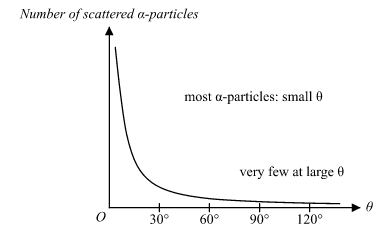 Conclusions:1. Most -particles pass through the foil undeflected or with very small deflection, so most of the space inside an atom is empty.2. Very few (about 1 in 8000) are deflected by more than and some almost bounce back, so all the positive charge and nearly all the mass of the atom are concentrated in a very small central region, the nucleus.(b)(ii) Bohr's rule does apply in principle, but is extremely small compared with the angular momentum of a planet.For the Earth: So .For such a huge quantum number, the allowed orbits (and energies) differ so little from one another that they form a practically continuous set. The quantization cannot be observed, so planetary motion is correctly described by classical mechanics (correspondence principle).
© examsnet.com
Go to Question: