Test Index
Nuclei
Nuclei

 CBSE Board Videos
© examsnet.com
Question : 22 of 23
Marks:
+1,
-0
(a) Depict the variation of the potential energy of a pair of nucleons with the separation between them.(b) Imagine the fission of a into two equal fragments of nucleus. Is the fission energetically possible ? Justify your answer by working out Q value of the process.Given : , .
[CBSE 2022 55/2/1]
Solution:
(a) Potential energy of a pair of nucleons as a function of their separation :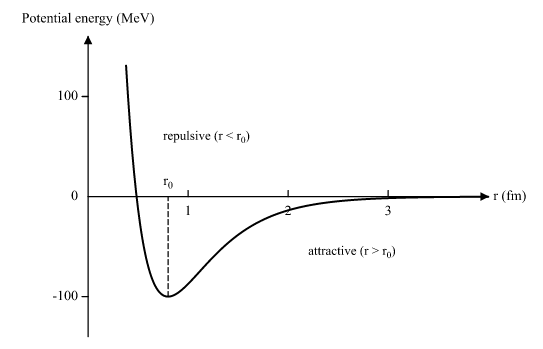 The potential energy is minimum (about ) at . For the force is attractive; for it is strongly repulsive. Beyond a few femtometres the potential energy is almost zero, so the nuclear force is short-ranged.(b)Concept: The reaction is possible on its own only if , whereSolution:Result: is negative, so the fission is not energetically possible. About would have to be supplied to split the iron nucleus.Key point: The two fragments together are heavier than the nucleus, because has nearly the highest binding energy per nucleon. Fission releases energy only for heavy nuclei (mass number above about 200).
© examsnet.com
Go to Question: