Test Index
Moving Charges and Magnetism
Moving Charges and Magnetism

 CBSE Board Videos
© examsnet.com
Question : 9 of 54
Marks:
+1,
-0
(a) (i) A rectangular loop of sides a and b carrying current I is placed in a magnetic field such that its area vector makes an angle with . With the help of a suitable diagram, show that the torque acting on the loop is given by , where is the magnetic dipole moment of the loop.(ii) A circular coil of 100 turns and radius carrying current of is suspended vertically in a uniform horizontal magnetic field of . The field makes an angle with the normal to the coil. Calculate :(I) the magnetic dipole moment of the coil, and(II) the magnitude of the counter torque that must be applied to prevent the coil from turning.OR(b) (i) Derive an expression for the force acting on a conductor of length L and area of cross-section A carrying current I and placed in a magnetic field .(ii) A part of a wire carrying current and bent at at two points is placed in a region of uniform magnetic field , as shown in the figure. Calculate the magnitude of the net force acting on the wire.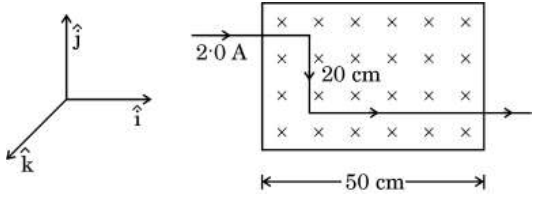
[CBSE 2026 55/5/2]
Solution:
(a)(i)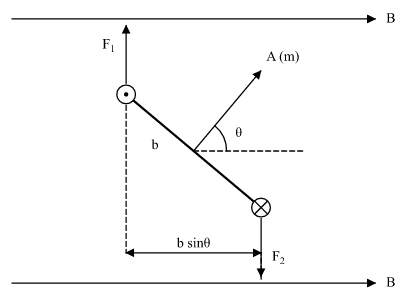 Let the loop be free to turn about an axis perpendicular to , with the sides of length a parallel to the axis. The figure is a top view: the loop is seen edge-on (side b), the area vector (normal to the loop) makes angle with .Forces on the sides of length b: they are equal, opposite and act along the same line (along the axis), so they cancel and give no torque.Forces on the sides of length a: each side is perpendicular to , so each experiencesThe currents in these two sides are opposite, so and are equal and opposite, but their lines of action are separated by a perpendicular distance . They form a couple. Net force is zero.Torque force arm:, where .The couple turns the loop so that (i.e. ) tends to line up with , which is the direction of . Magnitude and direction together give(For a coil of N turns, .)(a)(ii) Given: , , , , Area (I) (along the normal to the coil)(II) Torque due to the field: To stop the coil from turning, an equal and opposite counter torque is needed.Result: ; counter torque OR (b)(i)Let the conductor have free electrons per unit volume, each of charge , drifting with velocity .Number of free electrons in the conductor Lorentz force on one electron: Total force: The current is , flowing opposite to . Let be a vector of magnitude L along the current. Then .Magnitude , where is the angle between the conductor and ; the force is perpendicular to both the conductor and the field.(b)(ii) Given: , (into the page). Only the part of the wire inside the field region feels a force.Horizontal parts inside the field (along ): total length Vertical part (along ): length Horizontal parts: Vertical part: Net force: Result: net force Key point: In a uniform field, the force on a bent wire equals the force on a straight wire joining its entry and exit points: , giving the same .
© examsnet.com
Go to Question: