Test Index
Moving Charges and Magnetism
Moving Charges and Magnetism

 CBSE Board Videos
© examsnet.com
Question : 41 of 54
Marks:
+1,
-0
(a) (i) Write the principle and explain the working of a moving coil galvanometer. A galvanometer as such cannot be used to measure the current in a circuit. Why ?(ii) Why is the magnetic field made radial in a moving coil galvanometer ? How is it achieved ?OR(b) (i) Derive an expression for magnetic field on the axis of a current carrying circular loop.(ii) Write any two points of difference between a diamagnetic and a paramagnetic substance.
[CBSE 2023 55/3/1]
Solution:
(a)(i) Principle:A current-carrying coil placed in a magnetic field experiences a torque: .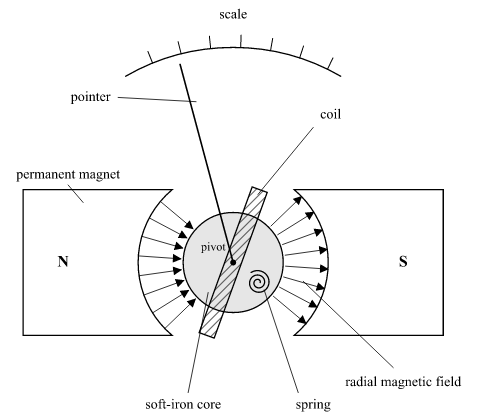 Working:The galvanometer has a coil of turns and area on a pivot between concave pole pieces, with a soft-iron cylindrical core, so the field is radial. When a current flows, the deflecting torque is (since always). The spring gives a restoring torque for a deflection . In equilibrium:So the deflection is proportional to the current, shown by the pointer on the scale.Why it cannot be used as such to measure current:(1) It is very sensitive: a current of a few microamperes gives full-scale deflection, so a normal circuit current would damage it.(2) Its resistance is not negligible; put in series, it would change the current being measured. (It is converted into an ammeter by connecting a small shunt resistance in parallel.)(a)(ii) Radial field:The field is made radial so that the plane of the coil is always parallel to the field lines in every position, i.e. the magnetic moment of the coil is always perpendicular to . Then , the torque does not depend on the deflection, and : the scale is linear.It is achieved by using concave (cylindrical) pole pieces of the magnet with a soft-iron cylindrical core placed between them.OR (b)(b)(i) Field on the axis of a circular loop:Consider a loop of radius carrying current , and a point P on its axis at distance from the centre O.
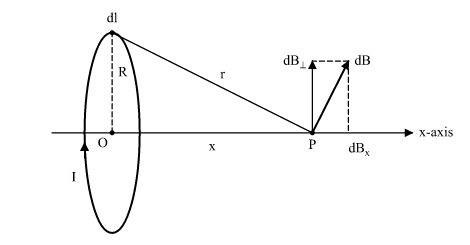 For an element , the vector to P has , and . By the Biot-Savart law: is perpendicular to the plane of and . Its component (perpendicular to the axis) is cancelled by that of the diametrically opposite element. Only the axial components add, with .directed along the axis (given by the right-hand thumb rule). At the centre (): .(b)(ii) Diamagnetic vs paramagnetic:1. Diamagnetic: susceptibility is small and negative (). Paramagnetic: is small and positive.2. Diamagnetic: relative permeability is slightly less than 1 (); it is weakly repelled by a magnet and moves from a stronger to a weaker field. Paramagnetic: is slightly greater than 1 (); it is weakly attracted by a magnet and moves from a weaker to a stronger field.
© examsnet.com
Go to Question: