Test Index
Moving Charges and Magnetism
Moving Charges and Magnetism

 CBSE Board Videos
© examsnet.com
Question : 36 of 54
Marks:
+1,
-0
(a) (i) State Biot-Savart's law for the magnetic field due to a current carrying element. Use this law to obtain an expression for the magnetic field at the centre of a circular loop of radius 'a' and carrying a current 'I'. Draw the magnetic field lines for a current loop indicating the direction of magnetic field.(ii) An electron is revolving around the nucleus in a circular orbit with a speed of . If the radius of the orbit is m, find the current constituted by the revolving electron in the orbit.OR(b) (i) Derive an expression for the force acting on a current carrying straight conductor kept in a magnetic field. State the rule which is used to find the direction of this force. Give the condition under which this force is (1) maximum, and (2) minimum.(ii) Two long parallel straight wires A and B are 2.5 cm apart in air. They carry 5.0 A and 2.5 A currents respectively in opposite directions. Calculate the magnitude of the force exerted by wire A on a 10 cm length of wire B.
[CBSE 2023 55/1/1]
Solution:
(a)(i) Biot–Savart law: The magnetic field at a point due to a current element is proportional to the current , the length and (the angle between and ), and inversely proportional to the square of the distance :, Field at the centre of a circular loop: Every element of the loop is at distance from the centre and perpendicular to the radius, so and :All the point the same way (along the axis of the loop), so they add:Result: , along the axis (direction by the right-hand thumb rule: fingers curl with the current, thumb gives ).Field lines of a current loop (loop seen edge-on):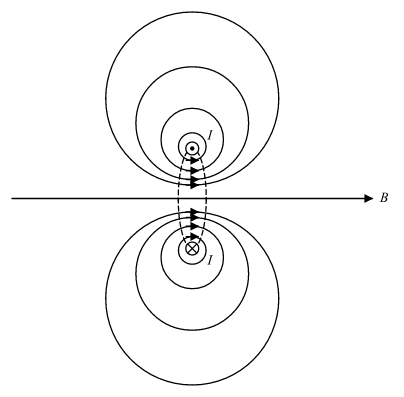 (a)(ii) The electron crosses any point of the orbit once every period .Result: A mAOR (b)(i) Consider a straight conductor of length and cross-section with free charge carriers (charge ) per unit volume, moving with drift velocity , in a uniform field .Force on one carrier: . Number of carriers .Since the current density and , (with along the current):, Rule: Fleming's left-hand rule: stretch the forefinger, middle finger and thumb of the left hand mutually perpendicular. If the forefinger points along the field and the middle finger along the current, the thumb gives the direction of the force.(1) Maximum force when (conductor perpendicular to ).(2) Minimum force when or (conductor parallel or antiparallel to ).(b)(ii) Given: A, A, cm m, cm mResult: N, repulsive (the currents are in opposite directions).
© examsnet.com
Go to Question: