Test Index
Moving Charges and Magnetism
Moving Charges and Magnetism

 CBSE Board Videos
© examsnet.com
Question : 15 of 54
Marks:
+1,
-0
(a) In which cases does a charged particle not experience a force in a magnetic field?(b) A square loop MNPK of side '' carrying a current '' is kept close to a long straight wire in the same plane and the wire carries a steady current as shown in the figure. Obtain the magnitude of magnetic force exerted by the wire on the loop.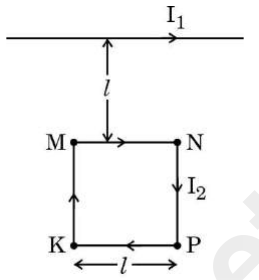
[CBSE 2025 55/4/3]
Solution:
(a)The magnetic force on a charge is , of magnitude . It is zero when:(i) the charged particle is at rest ();(ii) the particle moves parallel or antiparallel to the magnetic field ( or ).(b)Concept: A long straight wire produces ; the force on a straight conductor of length carrying current perpendicular to is . Parallel currents attract, antiparallel currents repel.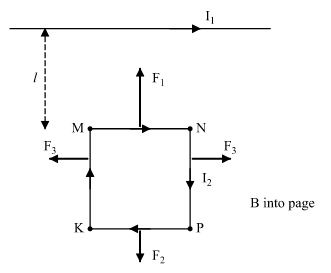 Side MN (distance , current in the same direction as ): attractive force, towards the wireSide PK (distance , current opposite to ): repulsive force, away from the wireSides NP and KM: they carry equal currents in opposite directions at identical positions relative to the wire, so the forces on them are equal and opposite and cancel.Net force Result: , directed towards the wire (net attraction).Key point: The answer does not depend on , because the side length cancels the distance in each force.
© examsnet.com
Go to Question: