Test Index
Moving Charges and Magnetism
Moving Charges and Magnetism

 CBSE Board Videos
© examsnet.com
Question : 1 of 54
Marks:
+1,
-0
Two particles of masses and having charges and respectively are projected with the same velocity in a region of uniform magnetic field pointing vertically upward. If they describe circular paths as shown in the figure, one may conclude that: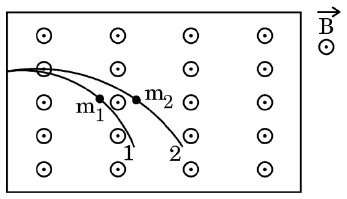
[CBSE 2026 55/4/3]
Solution: 👈: Video Solution
Concept:A charged particle moving perpendicular to a uniform magnetic field moves on a circle, with the magnetic force supplying the centripetal force:Solution:Both particles have the same and are in the same , so .From the figure, path 1 bends more sharply than path 2, so :Key point: Smaller radius means smaller (larger specific charge ).Answer:Option C ()
© examsnet.com
Go to Question: