Test Index
Electrostatic Potential and Capacitance
Electrostatic Potential and Capacitance

 CBSE Board Videos
© examsnet.com
Question : 2 of 28
Marks:
+1,
-0
(a) (i) Explain the following statements giving reason :(I) An equipotential surface through a point is normal to the electric field at that point.(II) When a dielectric is placed in an external electric field, the electric field inside the dielectric is less than that outside it.(III) The potential difference between the plates of a charged parallel plate capacitor decreases when its plates are brought closer.(ii) Obtain an expression for the work done to dissociate the system of three charges , and placed at the vertices A, B and C respectively of an equilateral triangle of side ''.OR(b) (i) Answer the following giving reason :(I) The electron drift speed is estimated to be only a few mm/s for currents in the range of a few amperes. How, then, is the current established almost the instant a circuit is closed ?(II) A low voltage supply from which one needs high currents must have very low internal resistance. Why ?(III) The assertion that is a statement of Ohm's law is not true. Why ?(ii) Two cells of emfs and are connected in parallel as shown in the figure. Their internal resistances are and respectively. Calculate the emf and internal resistance of the equivalent cell between points A and B.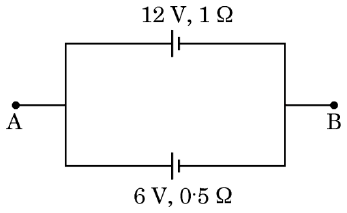
[CBSE 2026 55/4/3]
Solution: 👈: Video Solution
(a)(i)(I) No work is done in moving a test charge along an equipotential surface, since . Also . If had a component along the surface, moving the charge along it would need work, which contradicts . Hence , : the field is normal to the equipotential surface at every point.(II) The external field polarises the dielectric: its molecules acquire (or align) dipole moments along the field. This leaves bound charges on the surfaces, negative on the side facing the positive source and positive on the other side. These charges set up a field opposite to inside, so the net field is less than the field outside.(III) For a charged (isolated) capacitor the charge stays constant. , so , i.e. . Bringing the plates closer (smaller ) increases and decreases . (Equivalently, the field is unchanged and falls with .)(a)(ii)Potential energy of the system (, every pair separated by ):To dissociate the system the charges must be taken to infinity (where ), so the work needed isResult: Work done OR (b)(i)(I) When the circuit is closed, the electric field is set up throughout the conductor almost instantly (it travels at nearly the speed of light). Free electrons at every point of the wire start drifting at once, so the current begins everywhere at the same time. It does not wait for electrons to travel from one end of the wire to the other.(II) Current drawn . With a small emf , a large current is possible only if is small. The maximum current is (for ), so must be very low. A high internal resistance would also waste power inside the supply and lower the terminal voltage.(III) only defines resistance ; it holds for every conductor. Ohm's law states that is independent of (and ), i.e. with a straight-line - graph at constant temperature. Many devices (diodes, semiconductors, electrolytes, a filament at changing temperature) satisfy with changing with , so they do not obey Ohm's law.(b)(ii)Given: , ; , ; both cells have like terminals joined (parallel).Check: circulating current , so .Result: equivalent emf , internal resistance
© examsnet.com
Go to Question: