Test Index
Electromagnetic Waves
Electromagnetic Waves

 CBSE Board Videos
© examsnet.com
Question : 10 of 27
Marks:
+1,
-0
(a) State any three characteristics of electromagnetic waves.(b) Briefly explain how and where the displacement current exists during the charging of a capacitor.
[CBSE 2025 55/4/3]
Solution:
(a) (any three)1. Electromagnetic waves are transverse: the electric field , the magnetic field and the direction of propagation are mutually perpendicular.2. They do not need a material medium; in vacuum all of them travel with speed .3. The amplitudes of the fields are related by , and and oscillate in phase.4. They carry energy and momentum, and so exert radiation pressure on a surface.5. Being uncharged, they are not deflected by electric or magnetic fields.(b)While a capacitor is charging, a conduction current flows in the connecting wires, but no charge crosses the gap between the plates. In the gap the charge on the plates is changing, so the electric field and the electric flux between the plates change with time.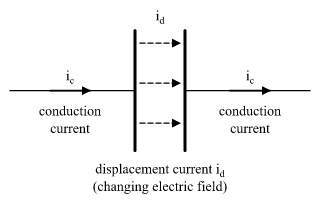 This changing electric flux is equivalent to a current called the displacement current:It exists in the region between the plates (and wherever the electric field changes with time). Since , , so the current is continuous through the circuit: conduction current in the wires, displacement current in the gap. It is included in the Ampere–Maxwell law ; once the capacitor is fully charged the field stops changing and becomes zero.
© examsnet.com
Go to Question: