Test Index
Electromagnetic Induction
Electromagnetic Induction

 CBSE Board Videos
© examsnet.com
Question : 3 of 34
Marks:
+1,
-0
(a) State Faraday's law of electromagnetic induction.(b) Derive an expression for the self-inductance of an air-filled long solenoid of length and cross-sectional area having turns.(c) A conducting rod of length , with one end pivoted, is rotated with angular speed of in a uniform magnetic field of directed perpendicular to the plane of rotation of rod. Find the emf induced in the rod.OR(a) Draw a labelled diagram of a step-up transformer. State the principle on which it works and obtain the ratio of secondary voltage to primary voltage in terms of number of turns and currents in the two coils.(b) The ratio of the number of turns in the primary to the secondary of an ideal transformer is . If power at is supplied to the primary, find(i) current in the primary, and(ii) output voltage.
[CBSE 2026 55/1/3]
Solution:
(a) Faraday's law: the magnitude of the emf induced in a circuit is equal to the time rate of change of the magnetic flux linked with the circuit. (for turns, ); the negative sign (Lenz's law) shows that the emf opposes the change in flux.(b) Let a current flow in the solenoid. Turns per unit length .Field inside a long air-filled solenoid: Flux through each turn: Total flux linkage: Since :(c)Given: , , A small element at distance from the pivot moves with speed , so :Result: Induced emf .OR (a) Step-up transformer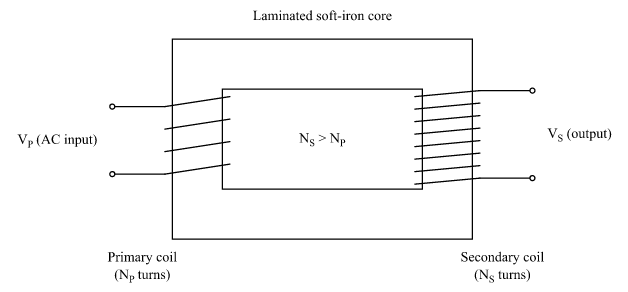 Principle: mutual induction. An alternating current in the primary produces an alternating magnetic flux in the soft-iron core; this changing flux links the secondary and induces an emf in it.Let be the flux through each turn at time (same for both coils, no flux leakage).EMF induced in the secondary ( turns): ...(1)Back emf in the primary ( turns): ...(2)With negligible coil resistance, (applied voltage), and with the secondary on open circuit or drawing small current, . Dividing (1) by (2):For an ideal transformer (no energy loss), input power = output power: , so .For a step-up transformer , so and .OR (b)Given: , , (i) (ii) Result: Primary current ; output voltage .
© examsnet.com
Go to Question: