Test Index
Electric Charges and Fields
Electric Charges and Fields

 CBSE Board Videos
© examsnet.com
Question : 17 of 29
Marks:
+1,
-0
(a) (i) State Coulomb's law in electrostatics and write it in vector form, for two charges.(ii) 'Gauss's law is based on the inverse-square dependence on distance contained in the Coulomb's law.' Explain.(iii) Two charges A (charge q) and B (charge 2q) are located at points (0, 0) and (a, a) respectively. Let and be the unit vectors along x-axis and y-axis respectively. Find the force exerted by A on B, in terms of and .OR(b) (i) Derive an expression for the electric field at a point on the equatorial plane of an electric dipole consisting of charges q and separated by a distance 2a.(ii) The distance of a far off point on the equatorial plane of an electric dipole is halved. How will the electric field be affected for the dipole ?(iii) Two identical electric dipoles are placed along the diagonals of a square ABCD of side m as shown in the figure. Obtain the magnitude and direction of the net electric field at the centre (O) of the square.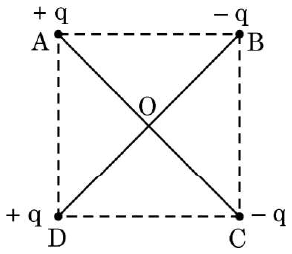
[CBSE 2023 55/1/1]
Solution:
(a)(i) Coulomb's law: The electrostatic force between two point charges is directly proportional to the product of their magnitudes and inversely proportional to the square of the distance between them, and acts along the line joining them.Vector form: , where is the force on due to and is the unit vector from to (and ).(a)(ii) Consider a point charge at the centre of a sphere of radius . By Coulomb's law the field on the sphere is , normal to the surface everywhere. Flux:The of the field cancels the of the surface area, so the flux is independent of (and of the shape of the closed surface). This is Gauss's law. If the force varied as with , the flux would depend on and Gauss's law would not hold.(a)(iii) , , Result: , magnitude , directed from A towards B (repulsion).OR (b)(i) Let the dipole have at A and at B, , centre O, and P a point on the equatorial line with . Dipole moment has magnitude , directed from to .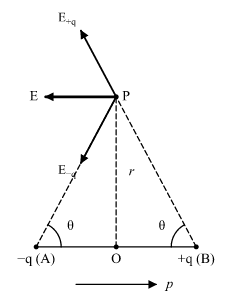 Distance of P from each charge , so is directed away from (along BP) and towards (along PA). Their components normal to the dipole axis cancel; the components along the axis add, both opposite to :, where Result: ; for , (b)(ii) For a far point, , so .At distance : The field becomes 8 times (direction unchanged, opposite to ).(b)(iii) Side m, so diagonal m and each charge is m from O.Charges: at A and D, at B and C. Let .Dipole along AC: field of (A) at O points away from A, along OC; field of (C) points towards C, along OC. along OCDipole along DB: similarly along OBThe diagonals of a square are perpendicular, so OB OC:Result: N/C ( in C), along the bisector of angle BOC, i.e. parallel to DC (from D towards C).
© examsnet.com
Go to Question: