Test Index
Dual Nature of Radiation and Matter
Dual Nature of Radiation and Matter

 CBSE Board Videos
© examsnet.com
Question : 7 of 41
Marks:
+1,
-0
A researcher performs an experiment on photo-electric effect using two metals A and B with unknown work functions. She illuminates the surfaces of A and B with monochromatic radiation of various frequencies and records the value of corresponding stopping potentials . The graph shows the variation of stopping potential with the frequency of incident radiation for metals A and B.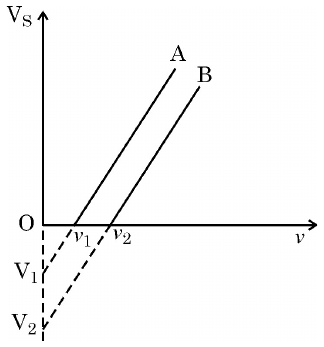 Answer the following questions :(I) From the graph, the work functions of A and B are ( is Planck's constant and value of charge on an electron)(A) and (B) and (C) and (D) and (II) For radiation of frequency incident on the surfaces of A and B, the maximum kinetic energy of ejected electron is(A) greater for metal A because it has a smaller work function.(B) greater for metal B because it has a larger work function.(C) greater for metal B because it has higher threshold frequency.(D) the same for both metal A and metal B because it is independent of work functions of metals.(III) If the intensity of the incident radiation for both metals A and B, is doubled keeping its frequency constant, then(A) the slope of the parallel lines will increase.(B) the slope of the parallel lines will decrease.(C) the threshold frequencies for both A and B will decrease.(D) the slope of the parallel lines will not change but more electrons will be emitted per second.(IV) The threshold frequency for a metal surface is . If the radiation of frequency illuminates the surface, the maximum kinetic energy (KE) of photoelectrons is . If the frequency were increased to , the maximum KE of the photoelectrons becomes . Then equals(A) (B) (C) (D) ORLet be the slope of the graph line for metal B. If is the value of electron charge, then Planck's constant '' is given by(A) (B) (C) (D)
[CBSE 2026 55/1/3]
Solution:
Concept:Einstein's photoelectric equation: , so The - graph is a straight line of slope (the same for every metal, so the lines are parallel). It cuts the -axis at the threshold frequency .(I) The lines cut the frequency axis at (A) and (B), so these are the threshold frequencies. Work function : , . (The intercepts , on the -axis equal in magnitude, a potential, not an energy.)Answer: (C) and (II) . For the same , the metal with the smaller work function gives the larger . Since , , so is greater for A.Answer: (A) greater for metal A because it has a smaller work function.(III) Slope is a constant and depends only on the metal; neither changes with intensity. Doubling the intensity doubles the number of photons per second, so more photoelectrons are emitted per second (larger photocurrent), with the same .Answer: (D) the slope of the parallel lines will not change but more electrons will be emitted per second.(IV) Answer: (C) OR (IV) From , slope , so .Answer: (A)
© examsnet.com
Go to Question: