Test Index
Dual Nature of Radiation and Matter
Dual Nature of Radiation and Matter

 CBSE Board Videos
© examsnet.com
Question : 35 of 41
Marks:
+1,
-0
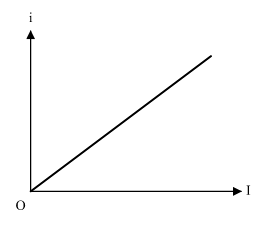
How does Einstein's photoelectric equation explain the emission of electrons from a metal surface ? Explain briefly.Plot the variation of photocurrent with :(a) collector plate potential for different intensity of incident radiation, and(b) intensity of incident radiation.
[CBSE 2023 55/1/1]
Solution:
Einstein's explanation:Light consists of photons, each of energy . In the photoelectric effect one photon is absorbed by one electron and gives it all its energy . Part of it is used to free the electron from the metal (the work function ); the rest appears as kinetic energy of the emitted electron:So an electron can be emitted only if , i.e. (threshold frequency), however intense the light. Above , increases linearly with and does not depend on intensity. Greater intensity means more photons, so more electrons and more photocurrent. Since one photon is absorbed in one elementary process, emission starts instantaneously.(a) Photocurrent against collector plate potential , for intensities (same frequency): the saturation current rises with intensity, but the stopping potential is the same.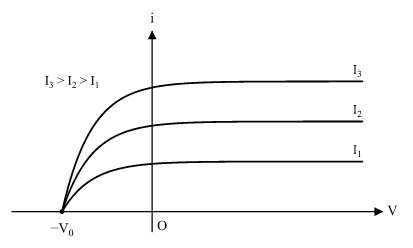 (b) Photocurrent against intensity (frequency above threshold): a straight line through the origin, .
© examsnet.com
Go to Question: