Test Index
Dual Nature of Radiation and Matter
Dual Nature of Radiation and Matter

 CBSE Board Videos
© examsnet.com
Question : 33 of 41
Marks:
+1,
-0
The figure shows versus graph for photoelectrons emitted from a surface where is the maximum speed of electrons and is the wavelength of incident radiation. Using this graph and Einstein's photoelectric equation, obtain the expression for Planck's constant and work function of the surface.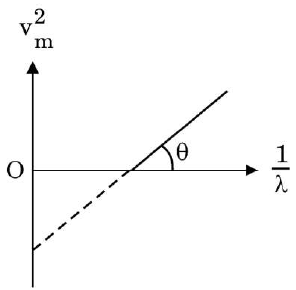
[CBSE 2023 55/4/1]
Solution:
Concept:Einstein's photoelectric equation: Solution:Multiplying by :This is a straight line with and , as in the graph.Slope Intercept on the -axis Result:Planck's constant: Work function: (Also, where the line cuts the -axis, , so with read from the graph.)
© examsnet.com
Go to Question: