Test Index
Dual Nature of Radiation and Matter
Dual Nature of Radiation and Matter

 CBSE Board Videos
© examsnet.com
Question : 20 of 41
Marks:
+1,
-0
When a photon of suitable frequency is incident on a metal surface, photoelectron is emitted from it. If the frequency is below a threshold frequency () for the surface, no photoelectron is emitted. For a photon of frequency , the kinetic energy of the emitted photoelectrons is . The photocurrent can be stopped by applying a potential called 'stopping potential' on the anode. Thus maximum kinetic energy of photoelectrons . The experimental graph between and for a metal is shown in figure. This is a straight line of slope m.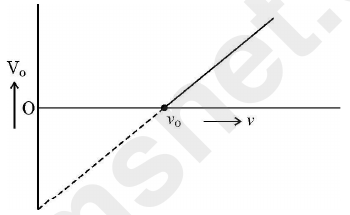 (i) The straight line graphs obtained for two metals(A) coincide each other.(B) are parallel to each other.(C) are not parallel to each other and cross at a point on -axis.(D) are not parallel to each other and do not cross at a point on -axis.(ii) The value of Planck's constant for this metal is(A) (B) (C) (D) (iii) The intercepts on -axis and -axis of the graph are respectively :(A) (B) (C) (D) ORWhen the wavelength of a photon is doubled, how many times its wave number and frequency become, respectively ?(A) (B) (C) (D) (iv) The momentum of a photon is kg m/s. Ignoring relativistic effects (if any), the wavelength of the photon is(A) (B) (C) (D)
[CBSE 2025 55/2/1]
Solution:
Concept:From :This is a straight line of slope and -intercept .(i) The slope is a universal constant, the same for every metal; only the threshold frequency (the -intercept) differs. So the lines for two metals have the same slope and different intercepts.Answer: (B) are parallel to each other.(ii) Answer: (C) (iii) -intercept: put : .-intercept: put : , i.e. a length on the negative -axis (the dashed extension of the line in the figure).Answer: (A) Key point: The -intercept lies below the origin; its value is and only its magnitude is . It equals , where is the work function.OR (iii) Wave number and frequency . Both vary as , so doubling makes each of them half.Answer: (B) (iv) de Broglie relation for a photon: Answer: (D)
© examsnet.com
Go to Question: