Test Index
Dual Nature of Radiation and Matter
Dual Nature of Radiation and Matter

 CBSE Board Videos
© examsnet.com
Question : 14 of 41
Marks:
+1,
-0
Answer the following, giving reasons:(a) The maximum kinetic energy of the photoelectrons is independent of the intensity of incident radiation.(b) Photoelectric current increases with the increase in the intensity of the incident radiation.(c) The stopping potential varies linearly with the frequency of the incident radiation for a given photosensitive surface.
[CBSE 2025 55/7/3]
Solution: 👈: Video Solution
Concept: Light consists of photons, each of energy . One photon is absorbed by one electron. Einstein's photoelectric equation: , where is the work function.(a)The energy given to an electron is the energy of one photon, , which depends only on the frequency. Increasing the intensity only increases the number of photons per second, not the energy of each photon. Hence does not depend on intensity.(b)Intensity is proportional to the number of photons falling on the surface per second. More photons eject more electrons per second (each photon ejects at most one electron), so the photoelectric current increases in proportion to the intensity (for ).(c)The stopping potential just stops the fastest electrons: For a given surface is constant, so this is a straight line () with slope (same for all metals), cutting the frequency axis at the threshold frequency .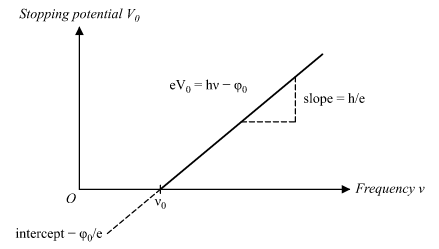
© examsnet.com
Go to Question: