Test Index

Current Electricity Get it on Google PlayDownload on the App Store CBSE Board Videos

© examsnet.com
Question : 9 of 50
Marks: +1, -0
(a) (i) Derive the condition for which a Wheatstone Bridge is balanced.
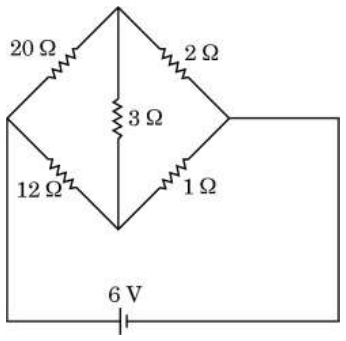
(ii) Determine the current in 3 Ω3\ \Omega branch of a Wheatstone Bridge in the circuit shown in the figure.
OR
(b) (i) Consider a cylindrical conductor of length ll and area of cross-section A. Current I is maintained in the conductor and electrons drift with velocity vdv_d (∣v⃗d∣=e∣E⃗∣mτ)\left(|\vec{v}_d| = \dfrac{e|\vec{E}|}{m}\tau\right), (where symbols have their usual meanings). Show that the conductivity σ\sigma of the material of the conductor is given by σ=ne2mτ\sigma = \dfrac{ne^2}{m}\tau.
(ii) The resistance of a metal wire at 20∘C20^\circ\text{C} is 1.05 Ω1.05\ \Omega and at 100∘C100^\circ\text{C} is 1.38 Ω1.38\ \Omega. Determine the temperature coefficient of resistivity of this metal.
[CBSE 2026 55/5/2]
Solution:  
(a)(i)
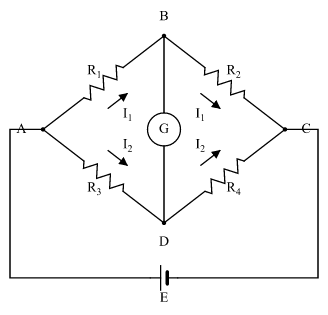
Four resistances R1R_1 (AB), R2R_2 (BC), R3R_3 (AD) and R4R_4 (DC) form the bridge; a galvanometer G is connected between B and D and a cell E between A and C. The bridge is balanced when no current flows through the galvanometer, Ig=0I_g = 0.
Then the same current I1I_1 flows in R1R_1 and R2R_2, and the same current I2I_2 in R3R_3 and R4R_4.
Kirchhoff's loop rule for loop ABDA: I1R1+IgG−I2R3=0I_1 R_1 + I_g G - I_2 R_3 = 0. With Ig=0I_g = 0: I1R1=I2R3I_1 R_1 = I_2 R_3 ...(1)
Loop BCDB: I1R2−I2R4−IgG=0I_1 R_2 - I_2 R_4 - I_g G = 0. With Ig=0I_g = 0: I1R2=I2R4I_1 R_2 = I_2 R_4 ...(2)
Dividing (1) by (2):
R1R2=R3R4\dfrac{R_1}{R_2} = \dfrac{R_3}{R_4}This is the balance condition. (Equivalently, B and D are at the same potential.)
(a)(ii)
Here 202=10≠121=12\dfrac{20}{2} = 10 \neq \dfrac{12}{1} = 12, so the bridge is not balanced and a current flows in the 3 Ω3\ \Omega arm.
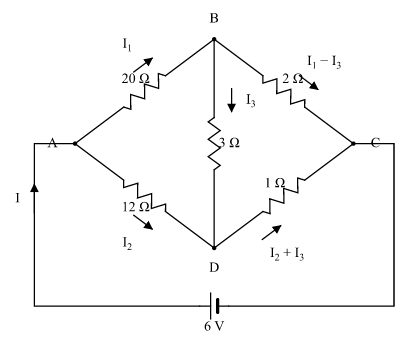
Name the junctions A (left, joined to the positive terminal), B (top), C (right) and D (bottom). Let I1I_1 flow in AB, I2I_2 in AD and I3I_3 from B to D. By the junction rule, BC carries I1−I3I_1 - I_3 and DC carries I2+I3I_2 + I_3. (Cell resistance is taken as zero.)
Loop ABDA: 20I1+3I3−12I2=020 I_1 + 3 I_3 - 12 I_2 = 0 ...(1)
Loop BCDB: 2(I1−I3)−1(I2+I3)−3I3=0⇒2I1−I2−6I3=02(I_1 - I_3) - 1(I_2 + I_3) - 3 I_3 = 0 \Rightarrow 2 I_1 - I_2 - 6 I_3 = 0 ...(2)
Loop ADC through the cell: 12I2+1(I2+I3)=6⇒13I2+I3=612 I_2 + 1(I_2 + I_3) = 6 \Rightarrow 13 I_2 + I_3 = 6 ...(3)
From (2): I2=2I1−6I3I_2 = 2 I_1 - 6 I_3. Put in (1): 20I1+3I3−24I1+72I3=0⇒I1=754I3=18.75 I320 I_1 + 3 I_3 - 24 I_1 + 72 I_3 = 0 \Rightarrow I_1 = \dfrac{75}{4} I_3 = 18.75\, I_3
Then I2=37.5I3−6I3=31.5 I3I_2 = 37.5 I_3 - 6 I_3 = 31.5\, I_3
Put in (3): 13×31.5 I3+I3=410.5 I3=613 \times 31.5\, I_3 + I_3 = 410.5\, I_3 = 6
I3=6410.5=12821 A≈0.0146 AI_3 = \dfrac{6}{410.5} = \dfrac{12}{821} \text{ A} \approx 0.0146 \text{ A}
(Check: I1=225821≈0.274 AI_1 = \dfrac{225}{821} \approx 0.274 \text{ A}, I2=378821≈0.460 AI_2 = \dfrac{378}{821} \approx 0.460 \text{ A}; along ABC, 20I1+2(I1−I3)=4500+426821=6 V20 I_1 + 2(I_1 - I_3) = \dfrac{4500 + 426}{821} = 6 \text{ V}.)
Result: current in the 3 Ω3\ \Omega branch =12821 A≈0.015 A= \dfrac{12}{821} \text{ A} \approx 0.015 \text{ A} (≈14.6 mA\approx 14.6 \text{ mA}), flowing from B (top) to D (bottom).
OR (b)(i)
Let n be the number of free electrons per unit volume. In time Δt\Delta t the electrons crossing a cross-section are those in a length vdΔtv_d\Delta t, i.e. nAvdΔtnAv_d\Delta t electrons, carrying charge neAvdΔtneAv_d\Delta t. So
I=neAvdI = neAv_d
Substituting vd=eEmτv_d = \dfrac{eE}{m}\tau:
I=neA eEmτ=ne2τmAEI = neA\,\dfrac{eE}{m}\tau = \dfrac{ne^2\tau}{m} A E
For a conductor of length ll with potential difference V across it, E=VlE = \dfrac{V}{l}:
I=ne2τm⋅Al V⇒R=VI=mne2τ⋅lAI = \dfrac{ne^2\tau}{m} \cdot \dfrac{A}{l}\, V \Rightarrow R = \dfrac{V}{I} = \dfrac{m}{ne^2\tau} \cdot \dfrac{l}{A}
Comparing with R=ρlAR = \rho\dfrac{l}{A}: ρ=mne2τ\rho = \dfrac{m}{ne^2\tau}
σ=1ρ=ne2mτ\sigma = \dfrac{1}{\rho} = \dfrac{ne^2}{m}\tau(Equivalently, current density j=IA=ne2τmEj = \dfrac{I}{A} = \dfrac{ne^2\tau}{m}E; comparing with j=σEj = \sigma E gives the same result.)
(b)(ii) Given: R1=1.05 ΩR_1 = 1.05\ \Omega at T1=20∘CT_1 = 20^\circ\text{C}, R2=1.38 ΩR_2 = 1.38\ \Omega at T2=100∘CT_2 = 100^\circ\text{C}
Neglecting the small change in the wire's dimensions, R∝ρR \propto \rho, so R2=R1[1+α(T2−T1)]R_2 = R_1[1 + \alpha(T_2 - T_1)]
α=R2−R1R1(T2−T1)=1.38−1.051.05×(100−20)=0.3384\alpha = \dfrac{R_2 - R_1}{R_1 (T_2 - T_1)} = \dfrac{1.38 - 1.05}{1.05 \times (100 - 20)} = \dfrac{0.33}{84}
Result: α≈3.9×10⁻³ ∘C−1\alpha \approx 3.9 \times 10^{-3}\ {}^\circ\text{C}^{-1}
© examsnet.com
Advertisements
Go to Question: