Test Index
Current Electricity
Current Electricity

 CBSE Board Videos
© examsnet.com
Question : 7 of 50
Marks:
+1,
-0
What is the order of magnitude of drift velocity of electrons in a conductor? Deduce the relation between the current flowing through a conductor and drift velocity of electrons in it.
[CBSE 2026 55/1/3]
Solution:
Order of magnitude:The drift velocity of free electrons in a metallic conductor is very small, of the order of a few mm/s (; typically a fraction of a millimetre to a few millimetres per second).Relation between current and drift velocity: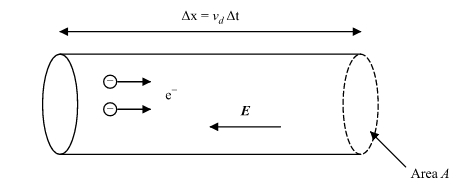 Consider a conductor of uniform cross-sectional area with free electrons per unit volume. An electric field is applied, so the electrons drift opposite to with drift velocity .In time each electron moves a distance . So all the electrons in a length of the conductor cross a given section in time .Volume of this part Number of electrons in it Charge crossing the section in time : (in magnitude; the charge is negative, , moving opposite to , which is a current along )Current Result: (a few mm/s); (so current density ).
© examsnet.com
Go to Question: