Test Index
Current Electricity
Current Electricity

 CBSE Board Videos
© examsnet.com
Question : 30 of 50
Marks:
+1,
-0
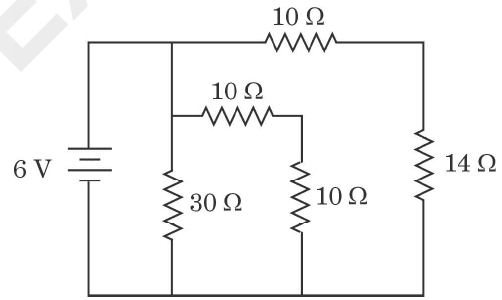
(a) (i) Define mobility of electrons. Give its SI units.(ii) A steady current flows through a wire AB, as shown in the figure. What happens to the electric field and the drift velocity along the wire ? Justify your answer.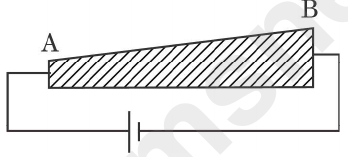 (iii) Consider the circuit shown in the figure. Find the effective resistance of the circuit and the current drawn from the battery.
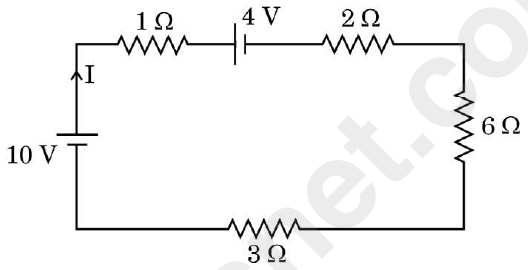
 OR(b) (i) Define electrical conductivity of a wire. Give its SI unit.(ii) High current is to be drawn safely from (1) a low-voltage battery, and (2) a high-voltage battery. What can you say about the internal resistance of the two batteries ?(iii) Calculate the total energy supplied by the batteries to the circuit shown in the figure, in one minute.
[CBSE 2023 55/4/1]
Solution:
(a)(i) Mobility () of electrons is the magnitude of the drift velocity per unit electric field:SI unit: (equivalently ).(a)(ii) The wire is thin at A and becomes thicker towards B. For a steady current, the same current flows through every cross-section.Drift velocity: . As the area increases from A to B, decreases along the wire.Electric field: , so (, , are constant). Hence the electric field also decreases from A to B (equivalently ).(a)(iii) The resistor, the branch and the branch are all connected between the same two points (the battery terminals), so they are in parallel:, , Result: effective resistance , current drawn from the battery .OR (b)(i) Electrical conductivity () of a material is the reciprocal of its resistivity, ; equivalently, the current density per unit electric field (). It measures how easily the material conducts current.SI unit: or .(b)(ii) (1) Low-voltage battery: to give a high current with a small emf, its internal resistance must be very low.(2) High-voltage battery: its internal resistance must be very high, so that the current stays within a safe limit even if the terminals are accidentally shorted ().(b)(iii) In the circuit, the cell is connected in opposition to the cell (the current enters its positive terminal). Total resistance .Kirchhoff's loop rule: Net energy supplied by the batteries in (all used as heat in the resistors):Check: Result: (the cell gives , of which is stored in the cell being charged).
© examsnet.com
Go to Question: