Test Index
Current Electricity
Current Electricity

 CBSE Board Videos
© examsnet.com
Question : 26 of 50
Marks:
+1,
-0
(a) What is meant by 'relaxation time' of free electrons in a conductor ? Show that the resistance of a conductor can be expressed by , where symbols have their usual meanings.OR(b) Draw the circuit diagram of a Wheatstone bridge. Obtain the condition when no current flows through the galvanometer in it.
[CBSE 2024 55/3/2]
Solution:
(a)Relaxation time (): the average time interval between two successive collisions of a free electron with the ions of the conductor, while it drifts under an applied electric field.Derivation:Let a conductor of length and area of cross-section have free electrons per unit volume, and let a potential difference be applied across it, so .Acceleration of an electron: . Drift velocity: ...(i)Current: ...(ii)Putting (i) in (ii): OROR (b)Wheatstone bridge: four resistances (AB), (BC), (AD) and (DC); a galvanometer G between B and D; a cell between A and C.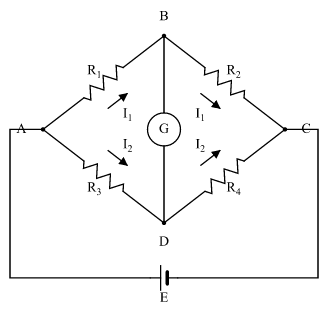 Condition for no current in G ():With , the current in AB also flows in BC, and the current in AD also flows in DC.Kirchhoff's loop rule for loop ABDA: ...(i)Loop BCDB: ...(ii)Dividing (i) by (ii):This is the balance condition of the Wheatstone bridge: B and D are then at the same potential.
© examsnet.com
Go to Question: