Test Index
Current Electricity
Current Electricity

 CBSE Board Videos
© examsnet.com
Question : 21 of 50
Marks:
+1,
-0
(a) Define ‘current density’. Is it a scalar or a vector ? An electric field is maintained in a metallic conductor. If n be the number of electrons (mass m, charge ) per unit volume in the conductor and its relaxation time, show that the current density , where .OR(b) What is a Wheatstone bridge ? Obtain the necessary conditions under which the Wheatstone bridge is balanced.
[CBSE 2024 55/1/2]
Solution:
(a)Current density: the current flowing per unit area of cross-section held normal to the direction of current, (SI unit ). It is a vector quantity; its direction is the direction of flow of positive charge (the direction of in a conductor).Derivation:A free electron (charge , mass ) in the field has acceleration . Between collisions it is accelerated, and averaged over all electrons (mean time between collisions , random initial velocities average to zero) the drift velocity isConsider area normal to . In time , all electrons within a distance cross it: number . The charge crossing isUsing :The electrons drift opposite to , but being negative they carry current along , so is parallel to :( is the conductivity ; this is Ohm's law in vector form.)OR (b)Wheatstone bridge: an arrangement of four resistances connected to form a closed quadrilateral ABCD, with a cell connected across one diagonal (A and C) and a galvanometer across the other diagonal (B and D). It is used to find an unknown resistance in terms of three known ones. The bridge is balanced when no current flows through the galvanometer.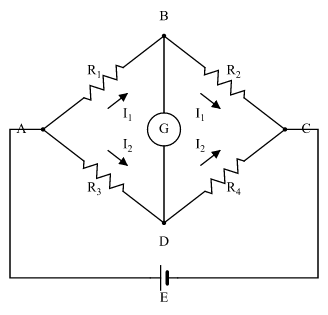 Balance condition:Let current flow in AB, in AD and from B to D through the galvanometer (resistance ). By the junction rule, the current in BC is and in DC is .Loop rule for loop ABDA: ...(1)Loop rule for loop BCDB: ...(2)At balance (points B and D are at the same potential):from (1): ...(3)from (2): ...(4)Dividing (3) by (4):This is the balance condition of the Wheatstone bridge; then an unknown .
© examsnet.com
Go to Question: