Test Index
Current Electricity
Current Electricity

 CBSE Board Videos
© examsnet.com
Question : 17 of 50
Marks:
+1,
-0
(a) Two wires of the same material and the same radius have their lengths in the ratio . They are connected in parallel to a battery which supplies a current of . Find the current through the wires.OR(b) In the circuit three ideal cells of e.m.f. , and are connected to a resistor of resistance , a capacitor of capacitance and another resistor of resistance as shown in figure. In the steady state find (i) the potential difference between P and Q and (ii) potential difference across capacitor .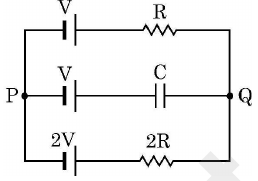
[CBSE 2025 55/2/1]
Solution:
(a)Concept: . Same material () and same radius (), so . In parallel both wires have the same p.d., so .Solution:, Result: The shorter wire carries and the longer wire carries .OR (b)Concept: In the steady state the capacitor is fully charged, so no current flows in the middle branch. A current flows only round the loop formed by the top (, ) and bottom (, ) branches. In each cell the long thin plate (positive terminal) is on the Q side.Current in the loop: The cells and oppose each other in this loop.It flows from P to Q through the bottom branch and from Q to P through the top branch.(i) Going from P to Q along the top branch: rise across the cell, and rise across (we move against the current).Check along the bottom branch: ✓So (Q is at the higher potential); the p.d. between P and Q is .(ii) Middle branch (no current): Result: (i) , with Q at the higher potential; (ii) across the capacitor, its plate on the Q side being positive.
© examsnet.com
Go to Question: