Test Index
Atoms
Atoms

 CBSE Board Videos
© examsnet.com
Question : 26 of 33
Marks:
+1,
-0
(a) Draw the energy level diagram for hydrogen atom. Mark the transitions corresponding to the series lying in the ultraviolet region, visible region and infrared region.OR(b) Draw a diagram to show the variation of binding energy per nucleon with mass number for different nuclei and mention its two features. Why do lighter nuclei usually undergo nuclear fusion ?
[CBSE 2023 55/1/1]
Solution:
(a)Energy of the levels: eV: , , , , eV, .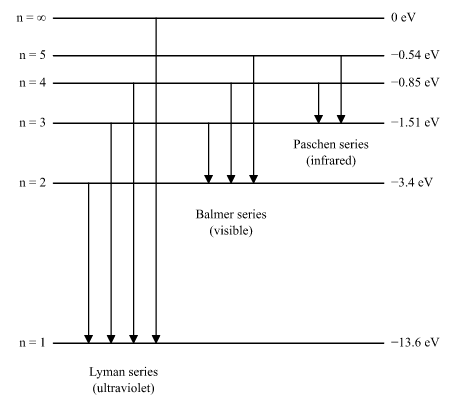 Transitions to give the Lyman series (ultraviolet region).Transitions to give the Balmer series (visible region).Transitions to give the Paschen series (infrared region). (Brackett, to , and Pfund, to , are also infrared.)OR (b)Binding energy per nucleon against mass number :
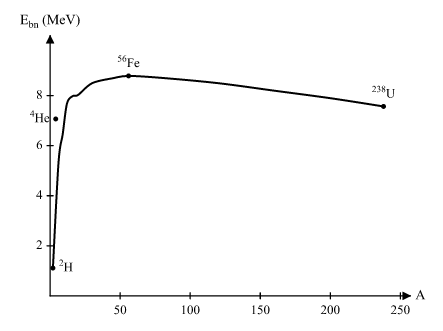 Features (any two):1. is practically constant (about MeV) for nuclei of middle mass number, .2. has a maximum of about MeV near (iron) and falls to about MeV for .3. is lower for both light nuclei () and heavy nuclei ().Why light nuclei undergo fusion: Light nuclei have a low binding energy per nucleon. When two light nuclei fuse into a heavier nucleus, the product has a higher binding energy per nucleon, i.e. it is more tightly bound (more stable). The increase in total binding energy is released as energy.
© examsnet.com
Go to Question: