Test Index
Atoms
Atoms

 CBSE Board Videos
© examsnet.com
Question : 22 of 33
Marks:
+1,
-0
Briefly explain Geiger-Marsden experiment. Show the variation of the number of particles scattered () with scattering angle () in this experiment. What is the main conclusion that can be inferred from this plot ?
[CBSE 2023 55/4/1]
Solution:
Geiger-Marsden experiment: A narrow beam of alpha particles from a radioactive source () in a lead box was directed at a very thin gold foil (about thick). The scattered alpha particles were detected by a rotatable detector: a zinc sulphide screen and a microscope. Each alpha particle striking the screen gave a flash of light (scintillation), and the number of particles scattered at different angles was counted. The whole set-up was kept in vacuum.Graph: number of scattered particles against scattering angle :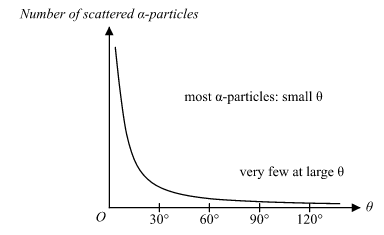 Most alpha particles pass almost undeviated (small ); falls very steeply as increases; only about 1 in 8000 is deflected by more than , and a very few bounce back ().Conclusion: Most of the atom is empty space. The entire positive charge and almost all the mass of the atom are concentrated in a very small central core, the nucleus (size about to , about of the atomic size). The strong repulsion of this concentrated charge causes the large-angle scattering; the experiment also gives an upper limit to the size of the nucleus.
© examsnet.com
Go to Question: