Test Index
CBSE Class 12 Physics 2022 Term 2 Delhi Set 1 Solved Paper
© examsnet.com
Question : 11 of 12
Marks:
+1,
-0
(a) (i) Arrange the following electromagnetic radiation in the ascending order of their frequencies:-rays, microwaves, gamma rays, radio waves3 (ii) Write two uses of any two of these radiation. OR(b) With the help of a ray diagram explain the working of a reflecting telescope. Mention two advantages of a reflecting telescope over a refracting telescope.3
Solution:
(a) (i) Arranging in ascending order of frequency:Radio waves, Microwaves, X-rays, Gamma ray(ii) Uses of X-ray: - to view bones and teeth, for diagnosing fractures. - to check for cracks or flaws in industrial materials.Uses of infra-red: - In heat-sensitive thermal imaging cameras. - In home remote controls. OR 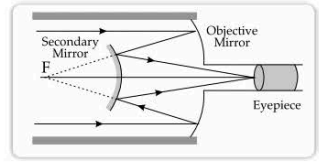 Parallel light rays from infinite distance initially are incident on two concave objective mirrors. After reflection they are incident on a secondary convex mirror. A virtual image is formed at . After reflection by the convex mirror, the rays meet at a point to form a real image which is observed by the eyepiece. Advantages of a reflecting telescope over a refracting telescope: - Mirrors can be made larger in size than lenses. - There is no chromatic aberrations.
© examsnet.com
Go to Question: