Test Index
CBSE Class 12 Physics 2017 Outside Delhi Set 1 Paper
© examsnet.com
Question : 26 of 26
Marks:
+1,
-0
(a) Define wavefront. Use Huygens' principle to verify the laws of refraction. (b) How is linearly polarised light obtained by the process of scattering of light? Find the Brewster angle for air - glass interface, when the refractive index of glass OR (a) Draw a ray diagram to show the image formation by a combination of two thin convex lenses in contact. Obtain the expression for the power of this combination in terms of the focal lengths of the lenses. (b) A ray of light passing from air through an equilateral glass prism undergoes minimum deviation when the angle of incidence is th of the angle of prism. Calculate the speed of light in the prism.
Solution:
(a) Definition of wavefront Verifying laws of refraction by Huygen's principle (b) Polarisation by scattering Calculation of Brewster's angle (a) The wavefront is the common locus of all points which are in phase(surface of constant phase) 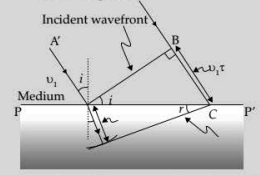 Let a plane wavefront be incident on a surface separating two media as shown. Let and be the velocities of light in the rarer medium and denser medium respectively. From the diagram This proves Snell's law of refraction. (b) When unpolarised light gets scattered by molecules, the scattered light has only one of its two components in it. (Also accept diagrammatic representation)
 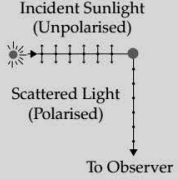 OR (a) Ray diagram Expression for power (b) Formula Calculation of speed of light
 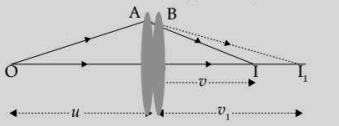 Two thin lenses, of focal length and are kept in contact. Let be the position of object and let be the object distance. The distance of the image (which is at ), for the first lens is . This image serves as object for the second lens. Let the final image be at I. We then have Adding, we get(b) At minimum deviationWe are given that Speed of light in the prism
© examsnet.com
Go to Question: