Test Index
CBSE Class 12 Physics 2017 Outside Delhi Set 1 Paper
© examsnet.com
Question : 24 of 26
Marks:
+1,
-0
SECTION - E
(a) Derive an expression for the electric field due to a dipole of length ' ' at a point distant from the centre of the dipole on the axial line. (b) Draw a graph of versus for . (c) If this dipole were kept in a uniform external electric field , diagrammatically represent the position of the dipole in stable and unstable equilibrium and write the expressions for the torque acting on the dipole in both the cases. OR (a) Use Gauss's theorem to find the electric field due to a uniformly charged infinitely large plane thin sheet with surface charge density . (b) An infinitely large thin plane sheet has a uniform surface charge density . Obtain the expression for the amount of work done in bringing a point charge from infinity to a point, distant , in front of the charged plane sheet.
Solution:
(a) Derivation of along the axial line of dipole (b) Graph between vs (c) (i) Diagrams for stable and unstable equilibrium of dipole (ii) Torque on the dipole in the two cases 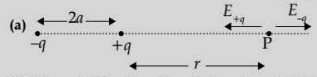 Electric field at due to charge Electric field at due to charge is Net electric Field at Its direction is parallel to .
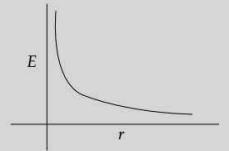 (For short Dipole without drawing the graph)
 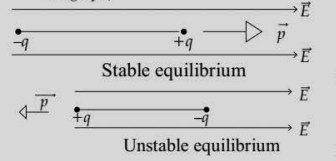 (i) For stable Equilibrium: is parallel to . (ii) For unstable equilibrium: is antiparallel to Torque for (i) as well as case (ii). (Also accept, OR (a) Using Gauss's theorem to find due to an infinite plane sheet of charge (b) Expression for the work done to bring charge from infinity to (a)
 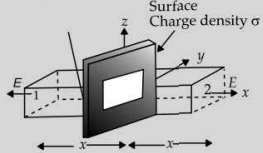 The electric field points outwards normal to the sheet. The field lines are parallel to the Gaussian surface except for surfaces 1 and 2 . Hence the net flux where is the area of each of the surface 1 and 2. (b)
© examsnet.com
Go to Question: