© examsnet.com
Question : 41 of 47
Marks: +1, -0
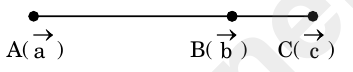
(a) Position vectors of the points A, B and C as shown in the figure below are a⃗\vec{a}, b⃗\vec{b} and c⃗\vec{c} respectively.
If AC→=54AB→\overrightarrow{AC} = \dfrac{5}{4} \overrightarrow{AB}, express c⃗\vec{c} in terms of a⃗\vec{a} and b⃗\vec{b}.
OR
(b) Check whether the lines given by equations x=2λ+2x = 2\lambda + 2, y=7λ+1y = 7\lambda + 1, z=−3λ−3z = -3\lambda - 3 and x=−μ−2x = -\mu - 2, y=2μ+8y = 2\mu + 8, z=4μ+5z = 4\mu + 5 are perpendicular to each other or not.
[CBSE 2023 65/1/3]
Solution:  
(a)
AC→=c⃗−a⃗\overrightarrow{AC} = \vec{c} - \vec{a} and AB→=b⃗−a⃗\overrightarrow{AB} = \vec{b} - \vec{a}
Given AC→=54AB→\overrightarrow{AC} = \dfrac{5}{4}\overrightarrow{AB}:
c⃗−a⃗=54(b⃗−a⃗)\vec{c} - \vec{a} = \dfrac{5}{4}(\vec{b} - \vec{a})
c⃗=a⃗+54b⃗−54a⃗\vec{c} = \vec{a} + \dfrac{5}{4}\vec{b} - \dfrac{5}{4}\vec{a}
Result: c⃗=5b⃗−a⃗4\vec{c} = \dfrac{5\vec{b} - \vec{a}}{4}
OR (b)
First line: x−22=y−17=z+3−3=λ\dfrac{x - 2}{2} = \dfrac{y - 1}{7} = \dfrac{z + 3}{-3} = \lambda, direction ratios ⟨2,7,−3⟩\langle 2, 7, -3 \rangle
Second line: x+2−1=y−82=z−54=μ\dfrac{x + 2}{-1} = \dfrac{y - 8}{2} = \dfrac{z - 5}{4} = \mu, direction ratios ⟨−1,2,4⟩\langle -1, 2, 4 \rangle
a1a2+b1b2+c1c2=2(−1)+7(2)+(−3)(4)=−2+14−12=0a_1a_2 + b_1b_2 + c_1c_2 = 2(-1) + 7(2) + (-3)(4) = -2 + 14 - 12 = 0
Result: The lines are perpendicular to each other.
© examsnet.com
Advertisements
Go to Question: