Test Index

Three Dimensional Geometry Get it on Google PlayDownload on the App Store CBSE Board Videos

© examsnet.com
Question : 40 of 43
Marks: +1, -0
Case Based / Data Based Question
Electrical transmission wires which are laid down in winters are stretched tightly to accommodate expansion in summers.
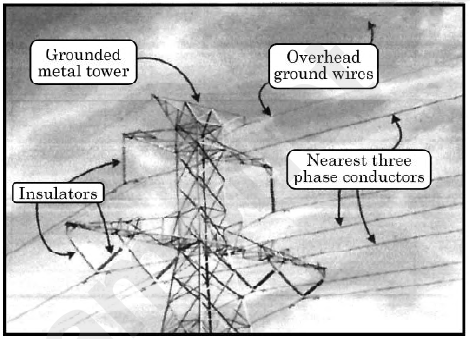
Two such wires lie along the following lines :
l1:x+13=y−3−2=z+2−1l_1 : \dfrac{x + 1}{3} = \dfrac{y - 3}{-2} = \dfrac{z + 2}{-1}
l2:x−1=y−73=z+7−2l_2 : \dfrac{x}{-1} = \dfrac{y - 7}{3} = \dfrac{z + 7}{-2}
Based on the given information, answer the following questions :
(i) Are the lines l1l_1 and l2l_2 coplanar ? Justify your answer. (2)
(ii) Find the point of intersection of the lines l1l_1 and l2l_2. (2)
[CBSE 2022 65/1/1]
Solution:  
(i)
l1l_1 passes through (x1,y1,z1)=(−1,3,−2)(x_1, y_1, z_1) = (-1, 3, -2) with direction ratios 3,−2,−13, -2, -1.
l2l_2 passes through (x2,y2,z2)=(0,7,−7)(x_2, y_2, z_2) = (0, 7, -7) with direction ratios −1,3,−2-1, 3, -2.
The lines are coplanar if ∣x2−x1y2−y1z2−z1a1b1c1a2b2c2∣=0\begin{vmatrix} x_2 - x_1 & y_2 - y_1 & z_2 - z_1 \\ a_1 & b_1 & c_1 \\ a_2 & b_2 & c_2 \end{vmatrix} = 0.
∣14−53−2−1−13−2∣=1(4+3)−4(−6−1)−5(9−2)=7+28−35=0\begin{vmatrix} 1 & 4 & -5 \\ 3 & -2 & -1 \\ -1 & 3 & -2 \end{vmatrix} = 1(4 + 3) - 4(-6 - 1) - 5(9 - 2) = 7 + 28 - 35 = 0
Hence the lines l1l_1 and l2l_2 are coplanar. (Their direction ratios are not proportional, so they are not parallel; they intersect.)
(ii)
Any point on l1l_1: (3λ−1, −2λ+3, −λ−2)(3\lambda - 1,\ -2\lambda + 3,\ -\lambda - 2)
Any point on l2l_2: (−μ, 3μ+7, −2μ−7)(-\mu,\ 3\mu + 7,\ -2\mu - 7)
Equating: 3λ−1=−μ3\lambda - 1 = -\mu ...(1), −2λ+3=3μ+7-2\lambda + 3 = 3\mu + 7 ...(2)
From (1): μ=1−3λ\mu = 1 - 3\lambda. In (2): −2λ+3=3−9λ+7⇒7λ=7⇒λ=1-2\lambda + 3 = 3 - 9\lambda + 7 \Rightarrow 7\lambda = 7 \Rightarrow \lambda = 1, μ=−2\mu = -2
Check z: −λ−2=−3-\lambda - 2 = -3 and −2μ−7=4−7=−3-2\mu - 7 = 4 - 7 = -3 (equal).
Result: Point of intersection =(2,1,−3)= (2, 1, -3)
© examsnet.com
Advertisements
Go to Question:

