Test Index

Three Dimensional Geometry Get it on Google PlayDownload on the App Store CBSE Board Videos

© examsnet.com
Question : 4 of 43
Marks: +1, -0
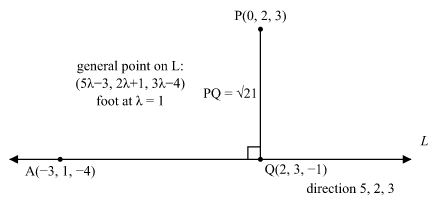
(a) Find the foot of the perpendicular from the point (0,2,3)(0, 2, 3) on the line −x−3−5=1−y−2=3z+129\dfrac{-x - 3}{-5} = \dfrac{1 - y}{-2} = \dfrac{3z + 12}{9} and hence find the length of the perpendicular.
OR
(b) Find the value of pp if the shortest distance between the lines
r⃗=(i^+2j^+k^)+λ(i^−j^+k^)\vec{r} = (\hat{i} + 2\hat{j} + \hat{k}) + \lambda(\hat{i} - \hat{j} + \hat{k}) and
r⃗=(pi^−j^−k^)+μ(2i^+j^+2k^)\vec{r} = (p\hat{i} - \hat{j} - \hat{k}) + \mu(2\hat{i} + \hat{j} + 2\hat{k})
is 32\dfrac{3}{\sqrt{2}} units.
[CBSE 2026 65/5/3]
Solution:  
(a)
Standard form of the line: −x−3−5=x+35\dfrac{-x - 3}{-5} = \dfrac{x + 3}{5}, 1−y−2=y−12\dfrac{1 - y}{-2} = \dfrac{y - 1}{2}, 3z+129=z+43\dfrac{3z + 12}{9} = \dfrac{z + 4}{3}, so
x+35=y−12=z+43=λ\dfrac{x + 3}{5} = \dfrac{y - 1}{2} = \dfrac{z + 4}{3} = \lambda (passes through (−3,1,−4)(-3, 1, -4), direction ratios 5,2,35, 2, 3).
Any point on the line: Q(5λ−3, 2λ+1, 3λ−4)Q(5\lambda - 3,\ 2\lambda + 1,\ 3\lambda - 4). With P(0,2,3)P(0, 2, 3):
PQ⃗=(5λ−3)i^+(2λ−1)j^+(3λ−7)k^\vec{PQ} = (5\lambda - 3)\hat{i} + (2\lambda - 1)\hat{j} + (3\lambda - 7)\hat{k}
PQ⊥PQ \perp line: 5(5λ−3)+2(2λ−1)+3(3λ−7)=05(5\lambda - 3) + 2(2\lambda - 1) + 3(3\lambda - 7) = 0
25λ−15+4λ−2+9λ−21=0⇒38λ=38⇒λ=125\lambda - 15 + 4\lambda - 2 + 9\lambda - 21 = 0 \Rightarrow 38\lambda = 38 \Rightarrow \lambda = 1
Foot of the perpendicular: Q(2,3,−1)Q(2, 3, -1).
Length: PQ=(2−0)2+(3−2)2+(−1−3)2=4+1+16=21PQ = \sqrt{(2 - 0)^2 + (3 - 2)^2 + (-1 - 3)^2} = \sqrt{4 + 1 + 16} = \sqrt{21}
Result: Foot (2,3,−1)(2, 3, -1); length of the perpendicular =21= \sqrt{21} units.
OR (b)
Formula used: d=∣(a⃗2−a⃗1)⋅(b⃗1×b⃗2)∣∣b⃗1×b⃗2∣d = \dfrac{\left|(\vec{a}_2 - \vec{a}_1)\cdot(\vec{b}_1 \times \vec{b}_2)\right|}{|\vec{b}_1 \times \vec{b}_2|}
Given: a⃗1=i^+2j^+k^\vec{a}_1 = \hat{i} + 2\hat{j} + \hat{k}, b⃗1=i^−j^+k^\vec{b}_1 = \hat{i} - \hat{j} + \hat{k}, a⃗2=pi^−j^−k^\vec{a}_2 = p\hat{i} - \hat{j} - \hat{k}, b⃗2=2i^+j^+2k^\vec{b}_2 = 2\hat{i} + \hat{j} + 2\hat{k}
b⃗1×b⃗2=∣i^j^k^1−11212∣=i^(−2−1)−j^(2−2)+k^(1+2)=−3i^+3k^\vec{b}_1 \times \vec{b}_2 = \begin{vmatrix} \hat{i} & \hat{j} & \hat{k} \\ 1 & -1 & 1 \\ 2 & 1 & 2 \end{vmatrix} = \hat{i}(-2 - 1) - \hat{j}(2 - 2) + \hat{k}(1 + 2) = -3\hat{i} + 3\hat{k}
∣b⃗1×b⃗2∣=9+9=32|\vec{b}_1 \times \vec{b}_2| = \sqrt{9 + 9} = 3\sqrt{2}
a⃗2−a⃗1=(p−1)i^−3j^−2k^\vec{a}_2 - \vec{a}_1 = (p - 1)\hat{i} - 3\hat{j} - 2\hat{k}
(a⃗2−a⃗1)⋅(b⃗1×b⃗2)=−3(p−1)+0−6=−3p−3=−3(p+1)(\vec{a}_2 - \vec{a}_1)\cdot(\vec{b}_1 \times \vec{b}_2) = -3(p - 1) + 0 - 6 = -3p - 3 = -3(p + 1)
d=3∣p+1∣32=∣p+1∣2=32d = \dfrac{3|p + 1|}{3\sqrt{2}} = \dfrac{|p + 1|}{\sqrt{2}} = \dfrac{3}{\sqrt{2}}
⇒∣p+1∣=3⇒p+1=3\Rightarrow |p + 1| = 3 \Rightarrow p + 1 = 3 or p+1=−3p + 1 = -3
Result: p=2p = 2 or p=−4p = -4.
Key point: The modulus in the formula gives two values of pp; both are valid.
© examsnet.com
Advertisements
Go to Question: