Test Index

Three Dimensional Geometry Get it on Google PlayDownload on the App Store CBSE Board Videos

© examsnet.com
Question : 2 of 43
Marks: +1, -0
Find the equation of a line (in vector and cartesian form) that passes through the point of intersection of lines x−12=y−23=z−34\dfrac{x-1}{2} = \dfrac{y-2}{3} = \dfrac{z-3}{4} and x−45=y−12=z\dfrac{x-4}{5} = \dfrac{y-1}{2} = z and is parallel to the vector 3i^+2j^−8k^3\hat i + 2\hat j - 8\hat k.
[CBSE 2026 65/4/1]
Concept: Write a general point of each line with a parameter, equate the coordinates to find the common point, then write the line through that point with the given direction.
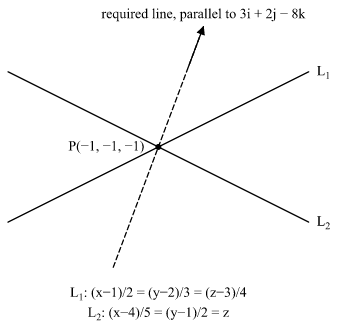
Solution:
General point of L1L_1: x−12=y−23=z−34=λ⇒(2λ+1, 3λ+2, 4λ+3)\dfrac{x-1}{2} = \dfrac{y-2}{3} = \dfrac{z-3}{4} = \lambda \Rightarrow (2\lambda + 1,\ 3\lambda + 2,\ 4\lambda + 3)
General point of L2L_2: x−45=y−12=z1=μ⇒(5μ+4, 2μ+1, μ)\dfrac{x-4}{5} = \dfrac{y-1}{2} = \dfrac{z}{1} = \mu \Rightarrow (5\mu + 4,\ 2\mu + 1,\ \mu)
At the point of intersection these are equal:
2λ+1=5μ+4⇒2λ−5μ=32\lambda + 1 = 5\mu + 4 \Rightarrow 2\lambda - 5\mu = 3 ...(i)
3λ+2=2μ+1⇒3λ−2μ=−13\lambda + 2 = 2\mu + 1 \Rightarrow 3\lambda - 2\mu = -1 ...(ii)
(i) ×3\times 3 −- (ii) ×2\times 2: −15μ+4μ=9+2⇒−11μ=11⇒μ=−1-15\mu + 4\mu = 9 + 2 \Rightarrow -11\mu = 11 \Rightarrow \mu = -1
From (i): 2λ=3−5=−2⇒λ=−12\lambda = 3 - 5 = -2 \Rightarrow \lambda = -1
Check the zz-coordinate: 4λ+3=−14\lambda + 3 = -1 and μ=−1\mu = -1 ✓ (the lines do intersect).
Point of intersection: P(−1,−1,−1)P(-1, -1, -1).
Required line passes through PP, i.e. a⃗=−i^−j^−k^\vec a = -\hat i - \hat j - \hat k, and is parallel to b⃗=3i^+2j^−8k^\vec b = 3\hat i + 2\hat j - 8\hat k.
Result:
Vector form: r⃗=(−i^−j^−k^)+t (3i^+2j^−8k^)\vec r = (-\hat i - \hat j - \hat k) + t\,(3\hat i + 2\hat j - 8\hat k)
Cartesian form: x+13=y+12=z+1−8\dfrac{x+1}{3} = \dfrac{y+1}{2} = \dfrac{z+1}{-8}
© examsnet.com
Advertisements
Go to Question:

