© examsnet.com
Question : 28 of 40
Marks: +1, -0
Recent studies suggest that roughly 12% of the world population is left handed.
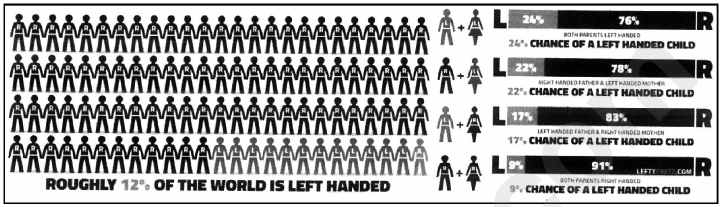
Depending upon the parents, the chances of having a left handed child are as follows :
A : When both father and mother are left handed :
Chances of left handed child is 24%.
B : When father is right handed and mother is left handed :
Chances of left handed child is 22%.
C : When father is left handed and mother is right handed :
Chances of left handed child is 17%.
D : When both father and mother are right handed :
Chances of left handed child is 9%.
Assuming that P(A)=P(B)=P(C)=P(D)=14P(A) = P(B) = P(C) = P(D) = \dfrac{1}{4} and L denotes the event that child is left handed.
Based on the above information, answer the following questions :
(i) Find P(L/C)P(L/C) (1)
(ii) Find P(Lˉ/A)P(\bar{L}/A) (1)
(iii) (a) Find P(A/L)P(A/L) (2)
OR
(iii) (b) Find the probability that a randomly selected child is left handed given that exactly one of the parents is left handed. (2)
[CBSE 2023 65/2/2]
Solution:  
Given: P(A)=P(B)=P(C)=P(D)=14P(A) = P(B) = P(C) = P(D) = \dfrac{1}{4}
P(L/A)=24100P(L/A) = \dfrac{24}{100}, P(L/B)=22100P(L/B) = \dfrac{22}{100}, P(L/C)=17100P(L/C) = \dfrac{17}{100}, P(L/D)=9100P(L/D) = \dfrac{9}{100}
(i)
P(L/C)=17100=0.17P(L/C) = \dfrac{17}{100} = 0.17
(ii)
P(Lˉ/A)=1−P(L/A)=1−24100=76100=1925P(\bar{L}/A) = 1 - P(L/A) = 1 - \dfrac{24}{100} = \dfrac{76}{100} = \dfrac{19}{25}
(iii) (a)
By the theorem of total probability:
P(L)=14(24100+22100+17100+9100)=14×72100P(L) = \dfrac{1}{4}\left(\dfrac{24}{100} + \dfrac{22}{100} + \dfrac{17}{100} + \dfrac{9}{100}\right) = \dfrac{1}{4} \times \dfrac{72}{100}
By Bayes' theorem:
P(A/L)=P(A)P(L/A)P(L)=14×2410014×72100=2472=13P(A/L) = \dfrac{P(A) P(L/A)}{P(L)} = \dfrac{\frac{1}{4} \times \frac{24}{100}}{\frac{1}{4} \times \frac{72}{100}} = \dfrac{24}{72} = \dfrac{1}{3}
OR (iii) (b)
"Exactly one parent is left handed" is the event B∪CB \cup C (BB and CC are mutually exclusive), with P(B∪C)=14+14=12P(B \cup C) = \dfrac{1}{4} + \dfrac{1}{4} = \dfrac{1}{2}.
P(L∩(B∪C))=P(B)P(L/B)+P(C)P(L/C)=14×22100+14×17100=39400P(L \cap (B \cup C)) = P(B) P(L/B) + P(C) P(L/C) = \dfrac{1}{4} \times \dfrac{22}{100} + \dfrac{1}{4} \times \dfrac{17}{100} = \dfrac{39}{400}
P(L/(B∪C))=P(L∩(B∪C))P(B∪C)=39/4001/2=39200P(L / (B \cup C)) = \dfrac{P(L \cap (B \cup C))}{P(B \cup C)} = \dfrac{39/400}{1/2} = \dfrac{39}{200}
Result: 39200=0.195\dfrac{39}{200} = 0.195
Key point: Adding 22100+17100=39100\dfrac{22}{100} + \dfrac{17}{100} = \dfrac{39}{100} is not a probability of L given B or C: it can exceed the chance for any single case. Divide P(L∩(B∪C))P(L \cap (B \cup C)) by P(B∪C)=12P(B \cup C) = \dfrac{1}{2}; the answer is the average of 22%22\% and 17%17\%.
© examsnet.com
Advertisements
Go to Question:

